← People

Raja Todar Mal

Raja Todar Mal: Todar Mal joined fiscal expertise to military service, helping develop Mughal revenue administration while linking the court’s ambitions to the resources of the countryside.

Died
1589 CE
Role
Imperial administrator and commander
Also known as
Todar Mal, Todar Mull
Region
South Asia, Mughal India

Imperial administrator and commander

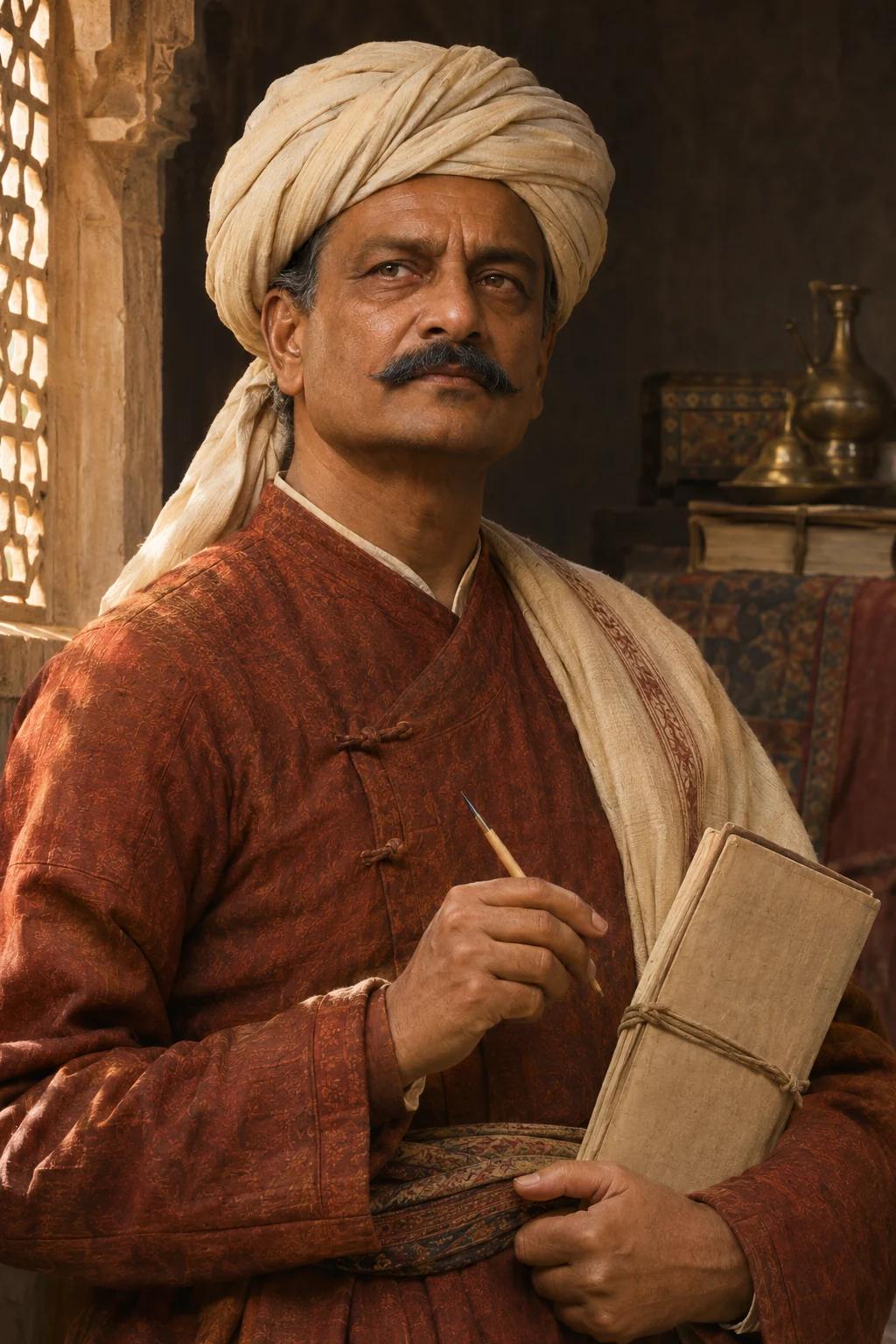
Illustrative reconstructed portrait of Raja Todar Mal in period clothing; an approximate likeness.
AI-assisted historical reconstruction

An illustrative reconstruction based on historical context. It is not a photograph or documentary likeness. Image policy Attribution

Life Journey

The official who turned fields into imperial accounts

Follow Raja Todar Mal through nine stages of a distinct historical life.

Complete chronology

Early sixteenth century

A career with an uncertain beginning

Later accounts attach competing dates and stories to Todar Mal's origins. They should not be combined into a confident childhood narrative. His importance lies in the demonstrable work of administration and command under Akbar. The combination of local knowledge and Persianate record-keeping could give a skilled official a route into an expanding state. His life also shows why Hindu participation in Mughal government was broader than the inclusion of Rajput princes.
Before the 1570s

Learning within an inherited system

Histories often associate his early experience with Sher Shah's administration, though the details and dates should be handled cautiously. The Sur and Mughal states worked within older systems of measurement, local rights and written accounts. An official could refine these practices by comparing records and adjusting collection. Recognising that inheritance does not diminish Todar Mal's achievement. It locates it within the accumulated labour of accountants, village officials and earlier administrations.

1560s–1570s

Finance and force

The modern separation between a civilian finance expert and a military commander does not fit his career neatly. Imperial officers could be employed in campaigns, negotiations and provincial assignments alongside fiscal tasks. Todar Mal's reputation for practical competence developed in this mixed world. The resources entered in a register had to be secured from territories with their own rulers and armed interests; administrative success could therefore depend on force as well as calculation.

1570s

Gujarat's revenues

Gujarat's contribution could not be understood only by counting the cities that had surrendered. Officials needed information about cultivation, existing claims and the expected flow of revenue. Assessment involved adapting imperial expectations to local records and political conditions. Todar Mal's association with this work belongs to a wider process of experimentation across the reign. A newly conquered province was a testing ground for the limits of a central regulation.

1574–1576

Campaigning in the east

Abu'l Fazl's account of the eastern campaign repeatedly places Todar Mal among the commanders arguing for determined action. That evidence complicates the familiar portrait of a minister occupied entirely with peaceful reform. The victory at Tukaroi led to a settlement with Daud Khan, followed by renewed conflict and Daud's defeat at Rajmahal in 1576. Military operations and the future organisation of provincial revenues were connected parts of imperial expansion.

Late 1570s

Making assessment more regular

Land measurement promised comparability, but it depended on the quality of tools, records and supervision. The countryside did not consist of identical fields with identical yields. Crop type, cultivation history and local prices affected assessment. Other officers, including Muzaffar Khan and Shah Mansur, also contributed to fiscal changes. Attributing every reform to Todar Mal alone replaces an evolving administrative process with a convenient biographical legend.

Around 1580

The ten-year settlement

The ten-year basis helped reduce the need to rebuild a rate schedule from uncertain prices each year. It did not eliminate changes in cultivation or guarantee a predictable burden for every household. Zabt assessment was most effective where surveys and records could support it; other regions continued with different methods. The distinction between a regulation's design and its local application is essential to understanding both Todar Mal's importance and the limits of the system bearing his reputation.

1580s

Language, office and the countryside

The increased use of Persian in accounts encouraged Hindu scribal groups to acquire the skills of the court's administrative language. Modern scholarship on accountancy shows this as a transformation in professional practice, not simply an order replacing one vocabulary with another. Manuals could prescribe accuracy and restraint while collectors faced pressure to produce income. Todar Mal's reforms should therefore be assessed through their effect on administration without assuming that every cultivator experienced them as relief.

1589 and beyond

Death and an enduring reputation

Abu'l Fazl praised his courage, knowledge of affairs and administrative ability, although their relationship was not free of disagreement. Later admiration made him a symbol of effective government. That reputation has a substantial basis, but it should not turn into a claim that one minister measured every field or invented a system applied everywhere. His achievement was to help an expanding empire organise knowledge and obligations more consistently. The consequences reached far beyond the court, into villages whose people rarely appear by name in its records.

Continue in context

Connected stories

Move from the profile into the wider events and settings this figure belongs to.

Keep exploring

Content note

This profile is written for educational use and connects to related Stories of History pages. The main portrait is an AI-assisted historical reconstruction, included as an illustrative aid rather than documentary evidence. Image policy Image attribution

References

Sources & Further Reading

Reliable reference works, archives and reading paths connected to this profile.

Sources used

  1. Najaf Haider / International Review of Social History, “Norms of Professional Excellence and Good Conduct in Accountancy Manuals of the Mughal Empire,” accessed 11 November 2026.

    Peer-reviewed article; publicly available abstract and PDF passage on Persian accounts, professional expertise and Todar Mal consulted. Chapter 6 and profile.

    Open source

Further reading

  1. Encyclopaedia Britannica, “Search results for Raja Todar Mal,” accessed June 2026.Open source
  2. WorldCat, “Books and library holdings for Raja Todar Mal,” accessed June 2026.Open source

Primary sources

  1. Abu'l Fazl / Packard Humanities Institute, “Akbarnama, volume III, translated by H. Beveridge,” accessed 11 November 2026.

    Consulted Gujarat, eastern campaigns, ten-year revenue settlement, religious discussions, Todar Mal and later political chronology; chapters 5–10. Includes later continuation material: do not attribute all final events to the author killed in 1602.

    Open source
  2. Abu'l Fazl / University of Exeter, “Ain-i-Akbari, volume II: selected English passages,” accessed 11 November 2026.

    H. S. Jarrett translation, corrected/annotated by Jadunath Sarkar: provincial officers, collector, record-keeper, land classes and Ten Years' Settlement. Regulations describe intended practice, not proof of compliance everywhere; chapter 6.

    Open source
  3. Library of Congress, “Search results for Raja Todar Mal,” accessed June 2026.Open source

Reviewed claim sources

Loading reviewed claim sources...

A monthly route through history

Find out first about the latest published stories, feature notes and occasional Premium offers in one monthly email.

If you are under the age of 18, please ensure you have the permission of your parent or guardian before subscribing.