Accessible gives a lighter overview. Deep Dive tells the fuller story.
Quick Answers
Who cracked Enigma?
Polish mathematicians first broke military Enigma before WWII. During the war, Turing, Welchman and colleagues at built on that work with engineers, operators, sailors and Allied partners to read changing German networks.
At a glance
Polish breakthrough: 1932.
Polish knowledge shared with Britain and France: July 1939.
Shark blackout begins February 1942; reading resumes December 1942.
Common questions
Did Alan Turing crack Enigma alone?
No. His major contributions formed part of a collaborative effort that built on Polish achievements and depended on many other specialists and organisations.
Was Enigma broken once and for all?
No. Changing keys and procedures required repeated attacks, and some traffic was delayed or never read.
Did Colossus break Enigma?
No. Colossus helped attack Lorenz traffic. The Bombe was the specialised machine associated with the wartime Enigma attack.
How did Enigma intelligence help win the war?
It helped reveal enemy activity and inform operations, including convoy routing, alongside aircraft, escorts, detection equipment and other intelligence.
Context
Introduction
Overview
A few meaningless letters could hide the course of a convoy, the position of a submarine or an order that would cost lives. During the Second World War, Germany trusted Enigma machines to protect its military messages. Breaking that protection took years of work: Polish mathematics, French intelligence, British invention, Allied engineering and courage at sea. This story follows the people and breakthroughs that turned intercepted signals into usable knowledge, and the setbacks that repeatedly threatened to close the way in.
What you’ll learn: How Enigma worked, why Poland’s breakthrough mattered, how the Bombe helped find settings, and how intelligence gained value in the fight at sea.
Key forces
Polish mathematicians achieved the first decisive military Enigma breakthrough before the war.
Enigma networks used changing settings and procedures; access had to be won repeatedly.
Turing, Welchman, Clarke, engineers, operators, sailors and Allied partners made different essential contributions.
Enigma intelligence supported operations alongside other intelligence and military capabilities; Colossus attacked Lorenz, a different cipher.
1926 CE
Step 1 of 101926 CEAccessible mode
A Machine That Changed Every Letter
A radio message could cross a battlefield in seconds. Anyone with a receiver could hear it. Enigma was meant to make sure that only the intended recipient could understand it.
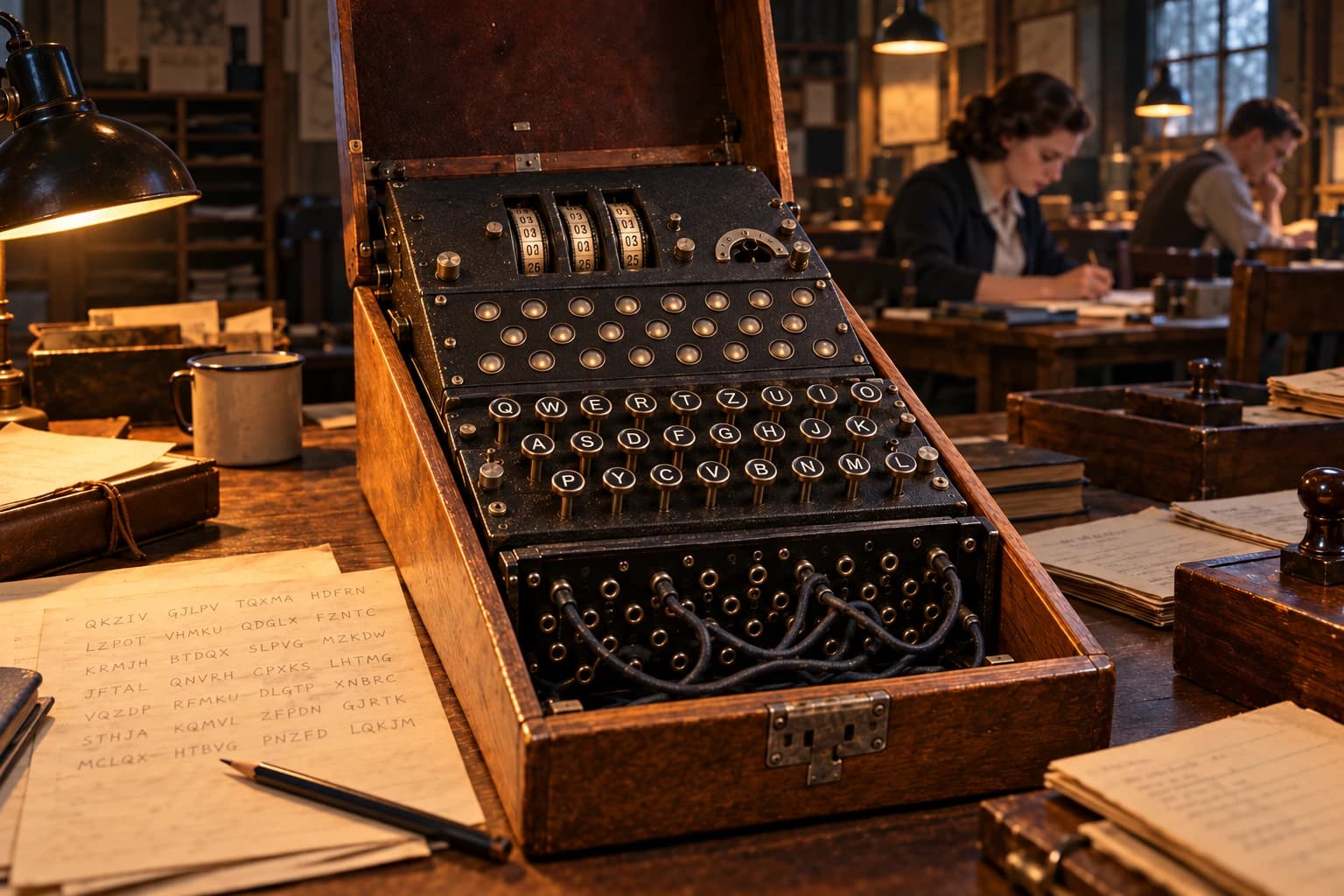
The machine looked like a small typewriter in a wooden case. Pressing a key sent electricity through wired rotors, then lit a different letter on a lampboard. The rotors moved as the operator typed, changing the substitutions again and again.
Military versions added a plugboard that swapped pairs of letters. Operators on the same network needed matching settings to recover the original message. Knowing how an Enigma worked was therefore very different from knowing its key.
“Understanding the machine was only the beginning.”
Germany trusted this moving maze of connections. Its enemies had to discover a way through before the information inside became useless.
1932 CE
Step 2 of 101932 CEAccessible mode
Poland Finds the First Way In
The first decisive breakthrough came in , years before became famous. Poland faced a powerful neighbour and needed to understand its military communications.
In 1932, Marian Rejewski used mathematics to reconstruct the workings of military Enigma. Information obtained by French intelligence helped him turn an apparently impossible puzzle into a problem that could be solved.
Rejewski, Jerzy Różycki and Henryk Zygalski developed ways to recover changing settings. Their tools included perforated sheets and the Polish bomba, a machine designed to exploit the message procedures then in use.
“The first opening into Enigma was made in Poland.”
This was a continuing contest. When Germany changed its equipment or rules, yesterday's method could become inadequate. By 1939, the Polish achievement was extraordinary, but the pressure on it was growing.
1939 CE
Step 3 of 101939 CEAccessible mode
A Secret Shared Before Invasion
In July 1939, Polish, British and French specialists met near . War was approaching, and the Polish Cipher Bureau revealed how far its work had advanced.
The visitors learned about reconstructed machines, recovered wiring and methods for finding keys. For the British, the meeting transformed the problem. They could build on years of Polish research instead of beginning again.
Germany invaded Poland in September. The codebreaking effort continued beyond the country's borders, including further Polish work in France.
“Knowledge crossed borders before armies closed them.”
The handover was neither a finished wartime solution nor a minor hint. It was a transfer of knowledge that made later breakthroughs possible. The next stage would require new methods, greater resources and a place where many kinds of expertise could work together.
Premium3 of 10 chapters read
Bletchley Builds a Listening War
The opening chapters reveal the Polish breakthrough and the secret shared before invasion. Continue through the cribs, turning drums, naval captures and setbacks that made Enigma intelligence an Allied advantage.