← People

Alan Turing

Alan Turing (1912–1954): A mathematician whose ideas helped shape modern computing, Turing brought logic and statistics to the Allied attack on Enigma before suffering persecution under Britain’s anti-gay laws.

Born
1912 CE
Died
1954 CE
Role
Mathematician and codebreaker
Full name
Alan Mathison Turing

Mathematician and codebreaker (1912–1954)

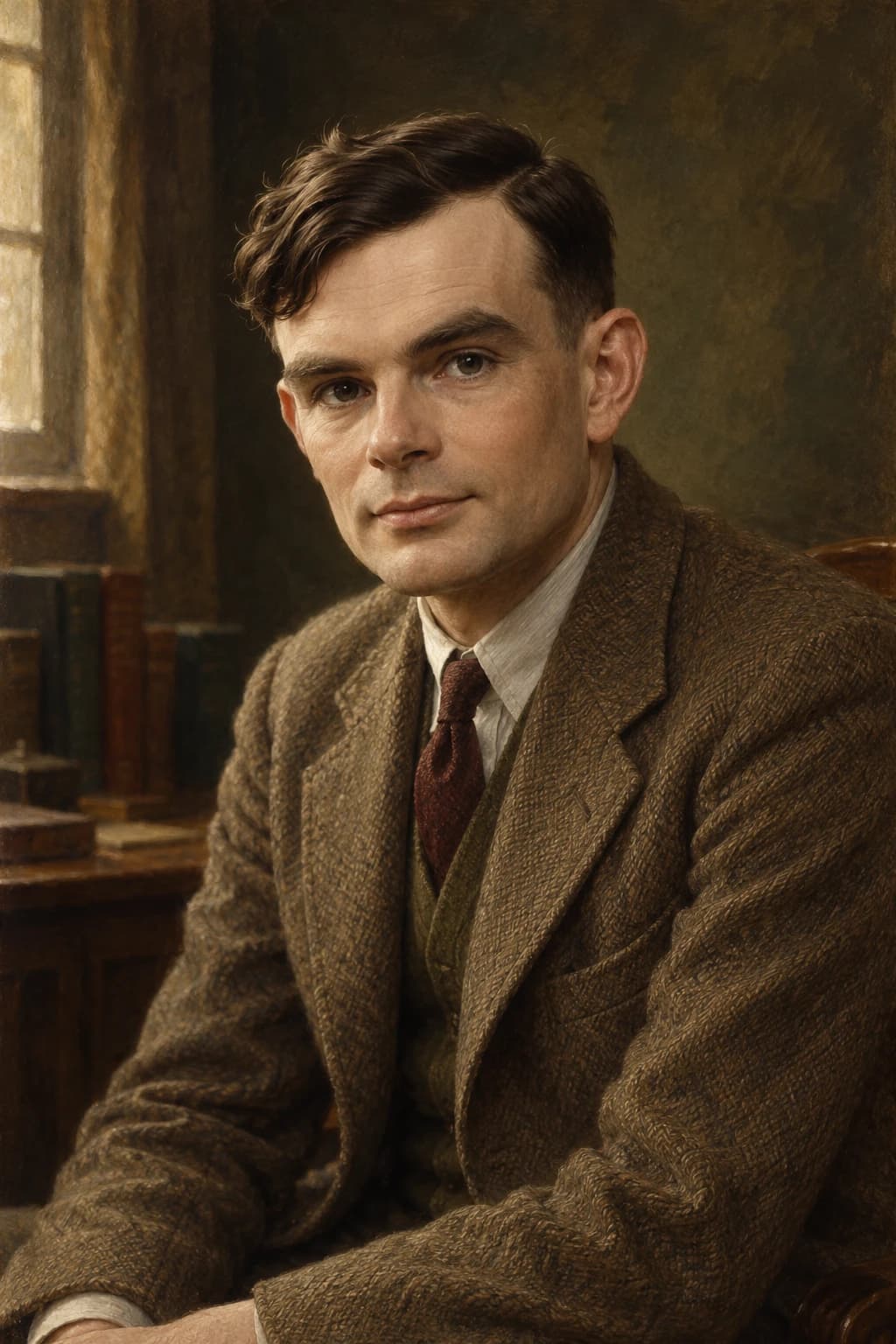
AI-generated portrait of Alan Turing in 1940s civilian clothing; an illustrative historical reconstruction, not a documentary likeness
AI-assisted historical reconstruction

An illustrative reconstruction based on historical context. It is not a photograph or documentary likeness. Image policy Attribution

Life Journey

From mathematical machines to the secret war

Follow Turing through computing, codebreaking, scientific exploration and the injustice of his final years.

Complete chronology

1912–1935

A mathematical education

Born in London in 1912, Alan Turing studied mathematics at King’s College, Cambridge. His research earned him a fellowship in 1935. At Cambridge, Turing developed an interest in the foundations of mathematics as well as probability. His early distinction preceded the wartime work that would later make his name widely known. A college fellowship gave him space to pursue questions about what reasoning could accomplish through fixed rules.
1936–1938

Imagining a universal machine

Turing described an abstract machine that followed instructions on a tape. His work helped establish the foundations of computer science. He then completed a doctorate at Princeton. His 1936 paper examined the limits of mechanical calculation. A universal machine could imitate other such machines when supplied with their instructions; it was a mathematical model, not a computer he had built. At Princeton he studied under Alonzo Church before returning to Britain in 1938.

1938–1939

Joining the secret war

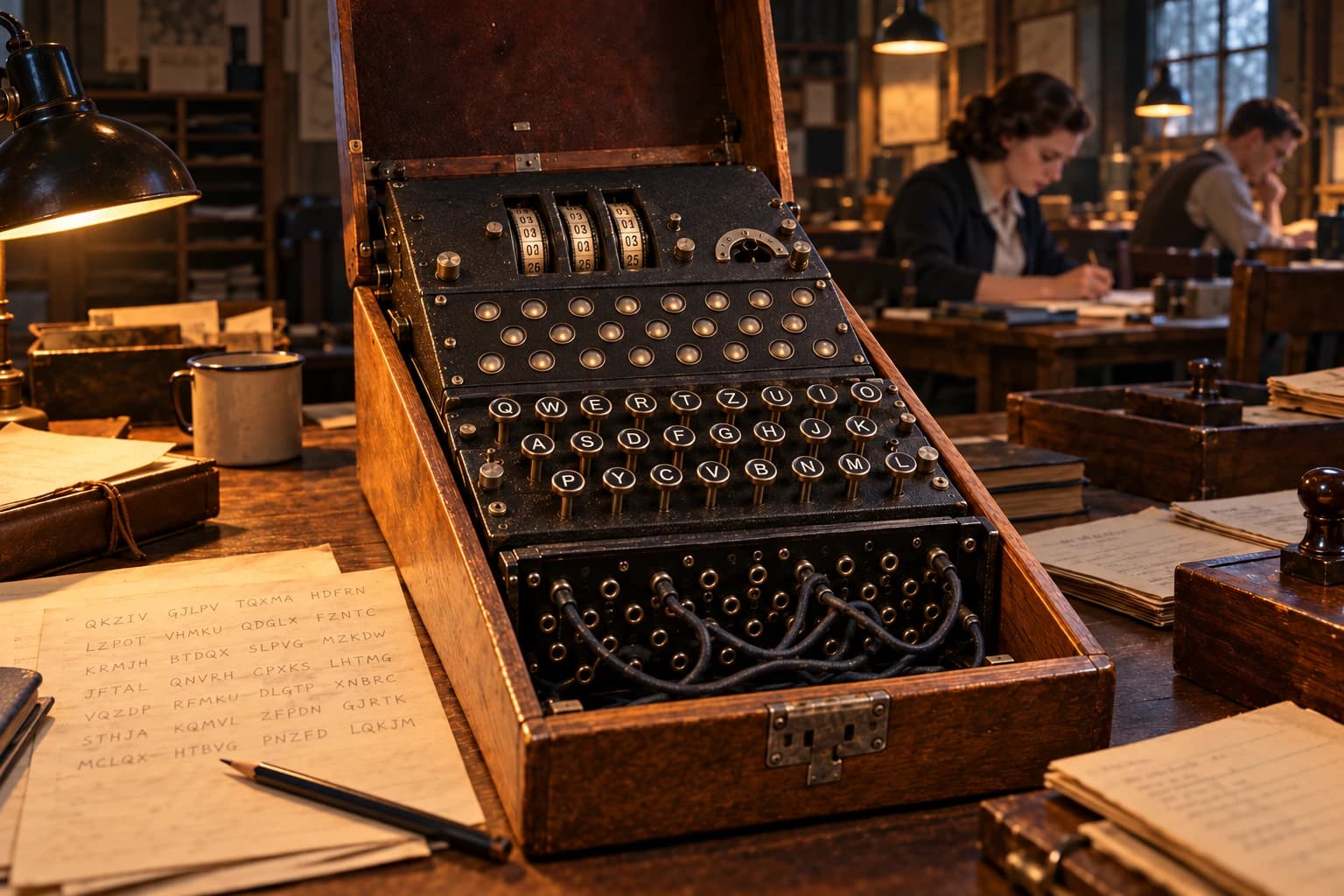
Recruited for British codebreaking before the war, Turing joined Bletchley Park in September 1939. He built on crucial earlier work by Polish cryptanalysts. Poland’s pre-war reconstruction of military Enigma gave Britain and France an essential starting point. Turing brought fresh methods to the expanding Government Code and Cypher School. Intercepts, shared knowledge and changing German procedures made the task a continuing struggle rather than a single solved puzzle.

1940

Logic becomes machinery

Turing’s Bombe design tested possible Enigma settings. Gordon Welchman’s diagonal board made the approach more effective, helping turn logical deductions into a practical search. The first British Bombe, Victory, began work in March 1940. Guessed message fragments, called cribs, supplied relationships that the machinery could test. Welchman’s improvement reduced the number of unhelpful results. Engineers and operators made this method usable at scale; the Bombe did not translate messages by itself.

1940–1942

Naval Enigma and Hut 8

Turing led Hut 8’s attack on naval Enigma. Joan Clarke became an expert in Banburismus, a statistical method that helped narrow the search for machine settings. Captured material, careful analysis and machinery helped Hut 8 read important U-boat traffic during 1941. Banburismus weighed evidence from intercepted messages to reduce possible rotor arrangements. Turing and Clarke briefly became engaged in 1941; after ending the engagement they remained friends. Their collaboration belonged to a wider team effort.

1942–1945

Beyond Enigma

Turing also worked on Lorenz messages, American collaboration and secure speech. These were distinct projects within a much larger Allied intelligence effort. His method called Turingery addressed Lorenz, a different German cipher from Enigma. He also travelled to the United States for wartime technical collaboration and later worked on secure speech communications. Colossus, designed by Tommy Flowers and his team, attacked Lorenz; it was not Turing’s Enigma-breaking computer.

1945–1952

Computers, intelligence and living patterns

After the war Turing designed the Automatic Computing Engine at the National Physical Laboratory, then worked at Manchester. He explored machine intelligence and mathematical patterns in biology. His 1950 paper considered how conversation might test a machine’s apparent intelligence. In 1952 he published a mathematical account of how interacting chemicals could produce biological patterns. Computing, logic and the study of living form remained connected by his interest in how complex behaviour could arise from rules.

1951–1954

Recognition alongside persecution

Elected to the Royal Society in 1951, Turing was prosecuted the following year for a sexual relationship with a man. He underwent hormonal treatment instead of imprisonment. British law criminalised consensual sexual activity between men. The conviction also cost Turing his security clearance, despite his wartime service. He continued scientific work, but national recognition offered no protection from discriminatory law. He died in June 1954, aged 41; the inquest returned a verdict of suicide.

1954–2013 and beyond

An enduring, contested legacy

Turing’s ideas became central to computing. As his wartime work became public, recognition grew. The British government apologised in 2009, and a royal pardon followed in 2013. The pardon acknowledged an injustice but did not undo the harm of his prosecution. Remembering Turing involves both his exceptional contributions and the people whose work made Allied codebreaking possible. His life also exposes a state’s capacity to value a person’s service while punishing their private life.

Continue in context

Connected stories

Move from the profile into the wider events and settings this figure belongs to.

Keep exploring

Content note

This profile is written for educational use and connects to related Stories of History pages. The main portrait is an AI-assisted historical reconstruction, included as an illustrative aid rather than documentary evidence. Image policy Image attribution

References

Sources & Further Reading

Reliable reference works, archives and reading paths connected to this profile.

Sources used

  1. King’s College, Cambridge, “Alan Mathison Turing (1912–54),” accessed 23 October 2026.

    Archive-based account of education, computing, morphogenesis and final years.

    Open source
  2. Bletchley Park, “Alan Turing: a brief biography,” accessed 23 October 2026.

    Wartime recruitment, naval Enigma, later projects and the inquest verdict.

    Open source
  3. The National Museum of Computing, “Enter Turing and Welchman,” accessed 23 October 2026.

    The British Bombe, cribs and Welchman’s diagonal board.

    Open source
  4. GCHQ, “Joan Clarke,” accessed 23 October 2026.

    Hut 8 collaboration, Banburismus and the continuing friendship.

    Open source
  5. Ministry of Justice, “Royal pardon for WW2 code-breaker Dr Alan Turing,” accessed 23 October 2026.

    The 1952 prosecution, loss of clearance and royal pardon of 24 December 2013.

    Open source

Further reading

  1. Encyclopaedia Britannica, “Search results for Alan Turing,” accessed June 2026.Open source
  2. WorldCat, “Books and library holdings for Alan Turing,” accessed June 2026.Open source

Primary sources

  1. Library of Congress, “Search results for Alan Turing,” accessed June 2026.Open source

Reviewed claim sources

Loading reviewed claim sources...

A monthly route through history

Find out first about the latest published stories, feature notes and occasional Premium offers in one monthly email.