This story discusses war, violence, persecution, and death in an educational historical context.
Reading mode
Accessible gives a lighter overview. Deep Dive tells the fuller story.
Quick Answers
Who were the Anglo-Saxons?
Anglo-Saxons is the name used for several peoples and kingdoms in early medieval Britain. They took shape through migration from the North Sea region and interaction with communities already living in Britain.
At a glance
The main narrative runs from around 410 to Alfred’s reign, with a look ahead to 1066.
Rival kingdoms such as ,,Mercia and emerged over several centuries.
Migration and local adaptation reshaped communities in parts of Britain after Roman government weakened.
Scandinavian armies conquered and settled in parts of England. endured and later rulers extended its power.
Common questions
Where did the Anglo-Saxons come from?
Many settlers came from the continental North Sea region. Bede described Angles,Saxons and Jutes, while archaeology and ancient DNA show a more varied picture of migration and interaction with people already living in Britain.
When was Anglo-Saxon England?
The period is conventionally dated from the end of Roman government around 410 to the Norman Conquest in 1066. This story follows the early kingdoms and Alfred’s reign, with a brief look at what came after.
Who was Alfred the Great?
Alfred ruled from 871 to 899. He defeated Guthrum at , strengthened his kingdom’s defences and supported learning and translation.
How did Anglo-Saxon England end?
William of Normandy defeated Harold Godwinson at Hastings in 1066 and became king. The Norman Conquest changed who held power in England, while many earlier institutions and practices endured.
Context
Introduction
Overview
After Roman authority faded in Britain, migration and settlement helped shape new kingdoms. Their rulers fought, converted to Christianity, supported learning and faced Scandinavian armies. Alfred’s endured, and later rulers built a wider English kingdom before the Norman Conquest in 1066.
Key forces
Migration and local adaptation reshaped communities in parts of Britain after Roman government weakened.
English kingdoms grew at different times and competed for land, tribute and influence.
Christian missions and royal patronage connected churches and monasteries to wider networks of learning.
Scandinavian armies conquered and settled in parts of England. endured and later rulers extended its power.
410 CE
Step 1 of 10410 CEAccessible mode
Rome Leaves Britain
For centuries, Roman rule had shaped life in Britain. Around 410, the links that held the province to the empire were coming apart.
Before this, towns, roads, taxes, and soldiers tied Britain to the Roman Empire. Local leaders worked inside that system, and many people still lived in a Roman way.
In the early fifth century, military commanders took troops to the Continent to fight for power there. Roman government in Britain weakened as those struggles went on.
Local leaders still had communities to defend. The written sources give glimpses of attacks from the north and from across the sea, while archaeology shows different ways people adapted.
Power became local. Some areas held together, others weakened, and new warriors and migrants found openings to settle and lead.
The old province was becoming a patchwork of local powers. Some of the people who would shape it came from across the North Sea.
450 CE
Step 2 of 10450 CEAccessible mode
Settlers Cross the North Sea
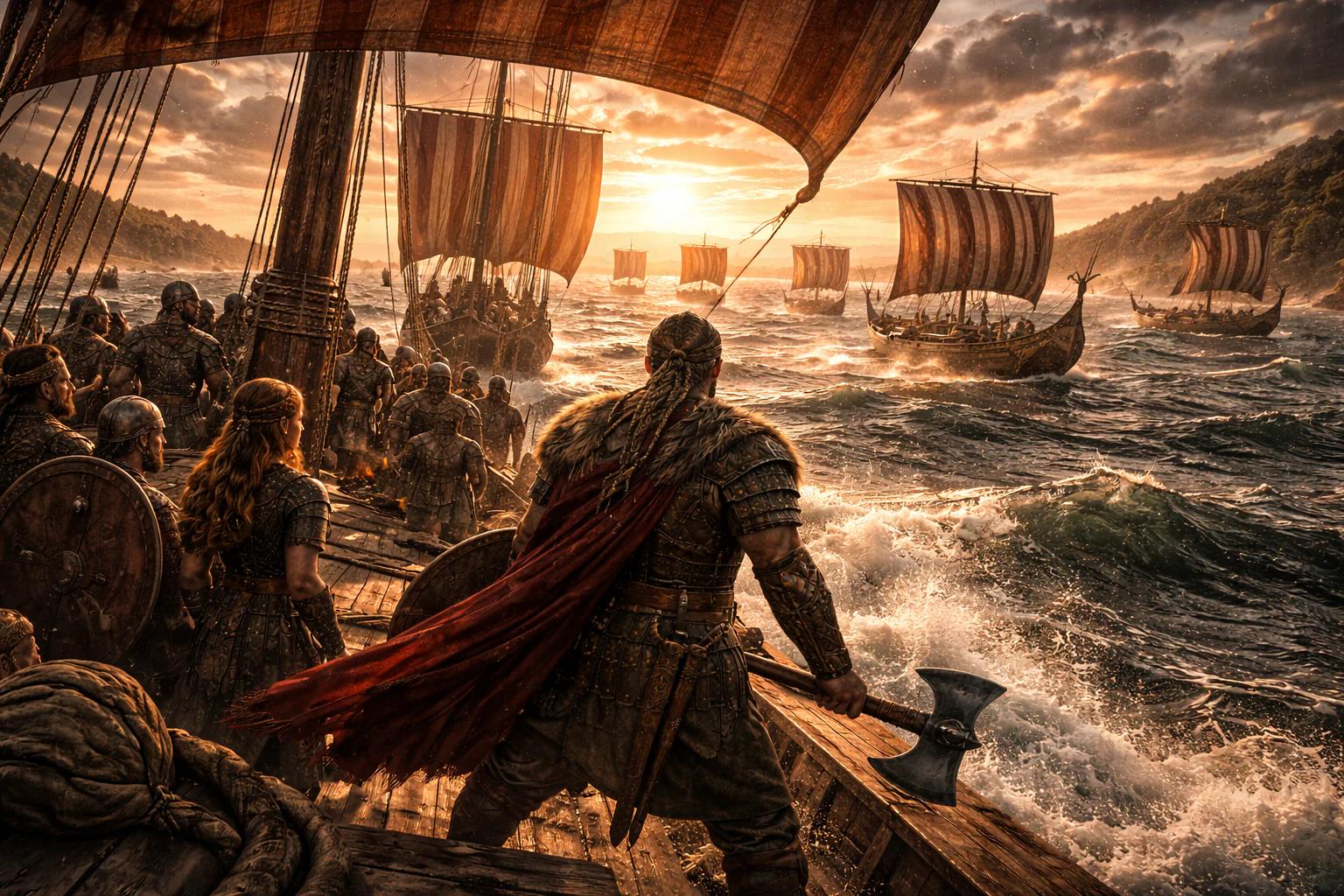
In the fifth century, people crossed the North Sea to settle in Britain. The crossing brought families and ways of life as well as warriors.
Life in Britain was unstable. Roman soldiers had gone, local leaders competed for power, and many communities had to defend themselves.
The historian Bede later called some of the newcomers Angles,Saxons and Jutes. Those names are useful, but people arrived from several places over many years.
There was fighting, but there was also settlement. Families crossed the sea, farms were built, and villages took shape in eastern and southern Britain.
Newcomers and people already living in Britain formed communities together. Early forms of English spread, and burial customs and ways of life changed at different speeds across the country.
This was the beginning of Anglo-Saxon England. Many place names, local identities, and early ideas of English society grew from these communities.
500 CE
Step 3 of 10500 CEAccessible mode
The First Anglo-Saxon Kingdoms
At first, Anglo-Saxon Britain was not a land of big kingdoms. It was a patchwork of villages, local war leaders, and small farming communities.
After Roman rule ended, different groups settled in different regions. People cleared land, built homes, farmed, and defended their own areas.
Over time, rulers drew strength from followers, land and alliances. Some used warfare to bring neighbouring communities under their control.
Kingdoms such as ,, and became visible in later records. They formed at different times and under different conditions.
This changed daily life. More people now lived under rulers who could demand service, settle disputes, and protect borders.
These early kingdoms helped shape the map and politics of England for centuries. Later kings and rivalries grew out of this first stage.
597 CE
Step 4 of 10597 CEAccessible mode
The Coming of Christianity
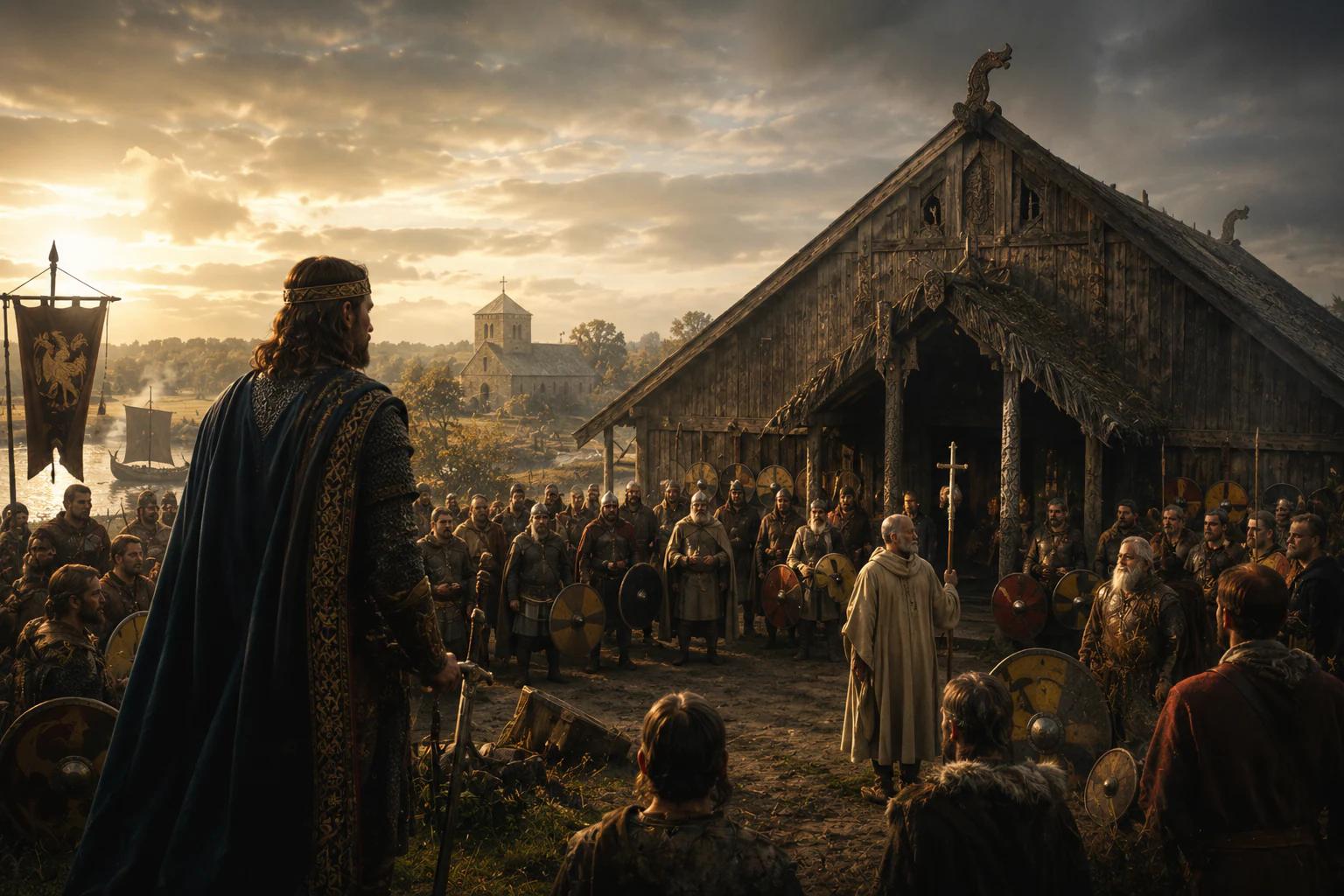
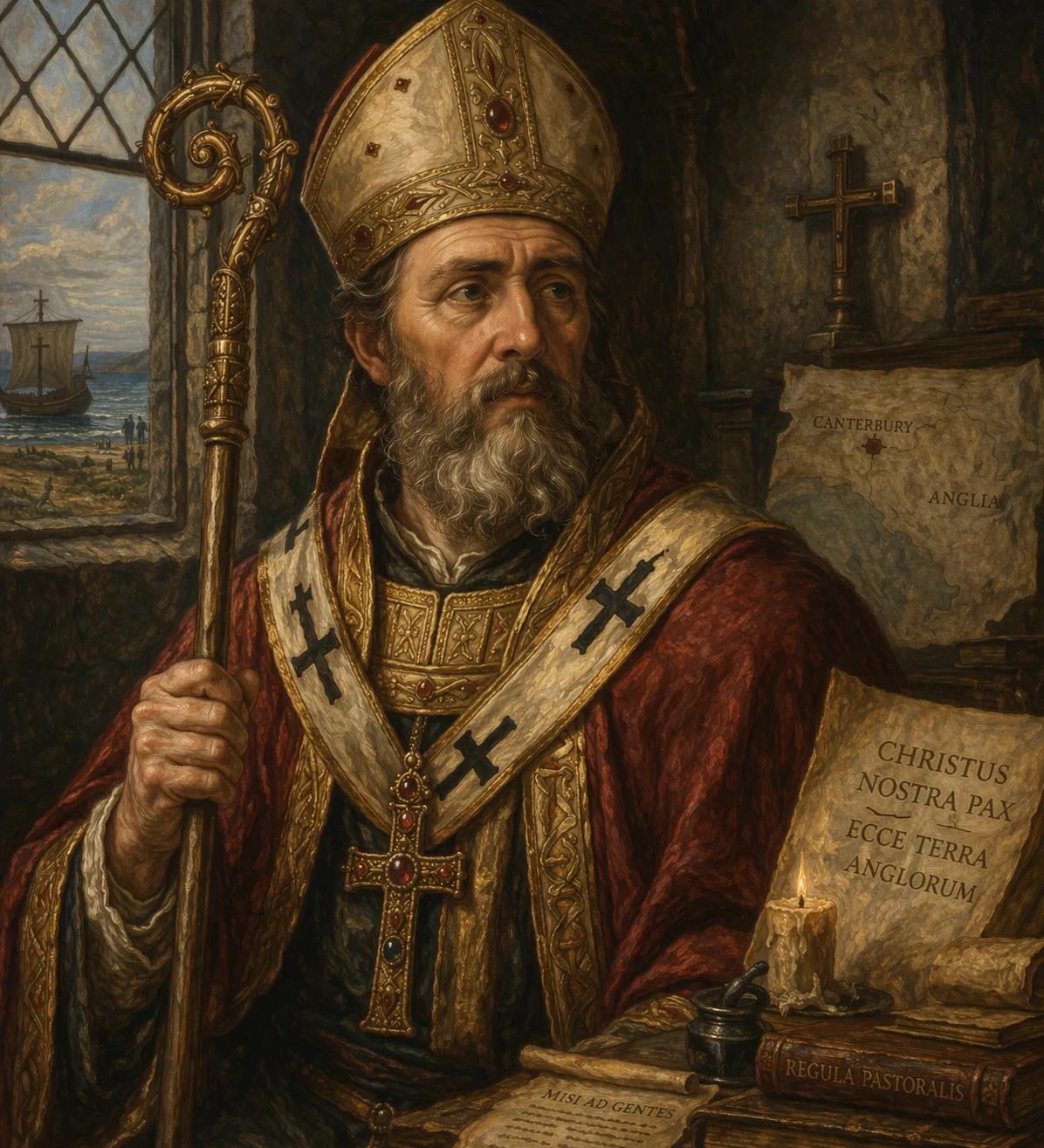
In 597, Augustine and his companions arrived in . Their mission helped spread Christianity among the English kingdoms, in a Britain where Christians had already lived for centuries.
Christianity survived Roman rule in parts of Britain. Many Anglo-Saxon communities followed older religious practices, which varied from place to place.
Æthelberht allowed Augustine to preach and later accepted baptism. Other kingdoms converted over generations, with help from missionaries working from centres such as Iona and .
Christian communities brought books and Latin learning into wider use in the English kingdoms.Monasteries became places of worship, teaching and manuscript production.
This linked Anglo-Saxon England more closely to Rome and to wider Europe. It helped create written law, recorded history, and institutions that would shape English life for centuries.
700 CE
Step 5 of 10700 CEAccessible mode
Northumbria and Mercia Rise
England was not one country yet. Around 700, the biggest kingdoms fought to see who would lead the rest.
Historians sometimes use heptarchy as shorthand for seven well-known kingdoms. The number of kingdoms and their boundaries changed over time.
grew strong in the north. Mercia expanded in the midlands. Both used war, marriage, and alliances to pull other regions under their control.
Kings demanded tribute, led armies, and rewarded followers with land and treasure. When one kingdom defeated another, it could force obedience without ruling every village directly.
This changed everyday life. People paid taxes or tribute to distant rulers, served in war, and lived with shifting borders and loyalties.
Overlordship let some kings hold power beyond their own lands for a time. Their influence often weakened when they died or lost a battle.
731 CE
Step 6 of 10731 CEAccessible mode
A Culture of Learning and Law
By the early eighth century, books and laws were travelling between the courts and monasteries of the English kingdoms.
Much knowledge passed by word of mouth. People also wrote in runes, and Christian communities made wider use of the Latin alphabet.
Monasteries copied books and connected English scholars with people and texts overseas.
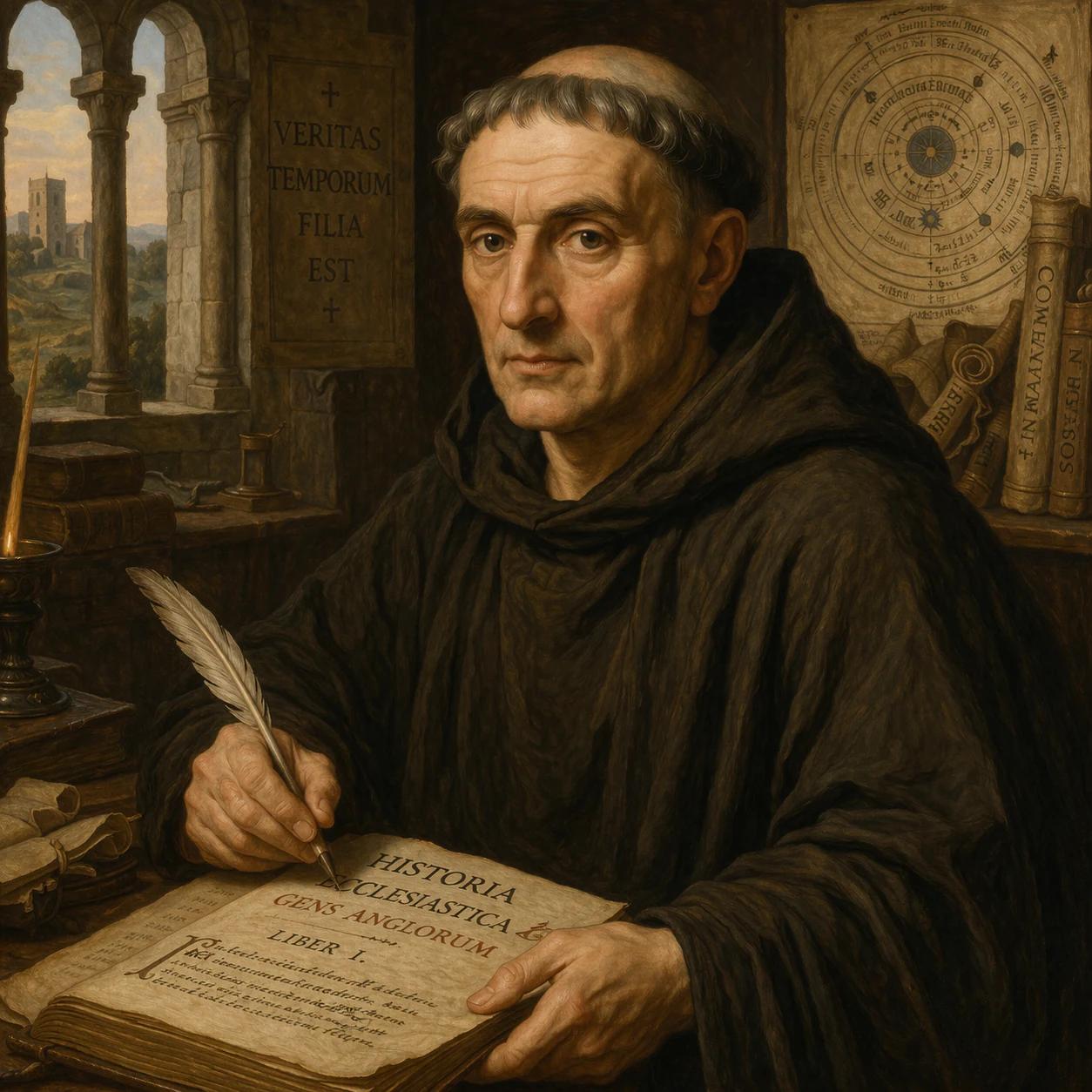
Writers like Bede showed this new world in action. In 731, his history of the English people gathered stories, dates, and rulers into one bigger picture.
Kings also issued laws. The earliest surviving English code is associated with Æthelberht of Kent and was written in Old English.
Bede's history and the early laws give us two views of the period. One tells how the Church grew, while the other sets out what rulers wanted their people to do.
757 CE
Step 7 of 10757 CEAccessible mode
Offa Builds Mercian Power
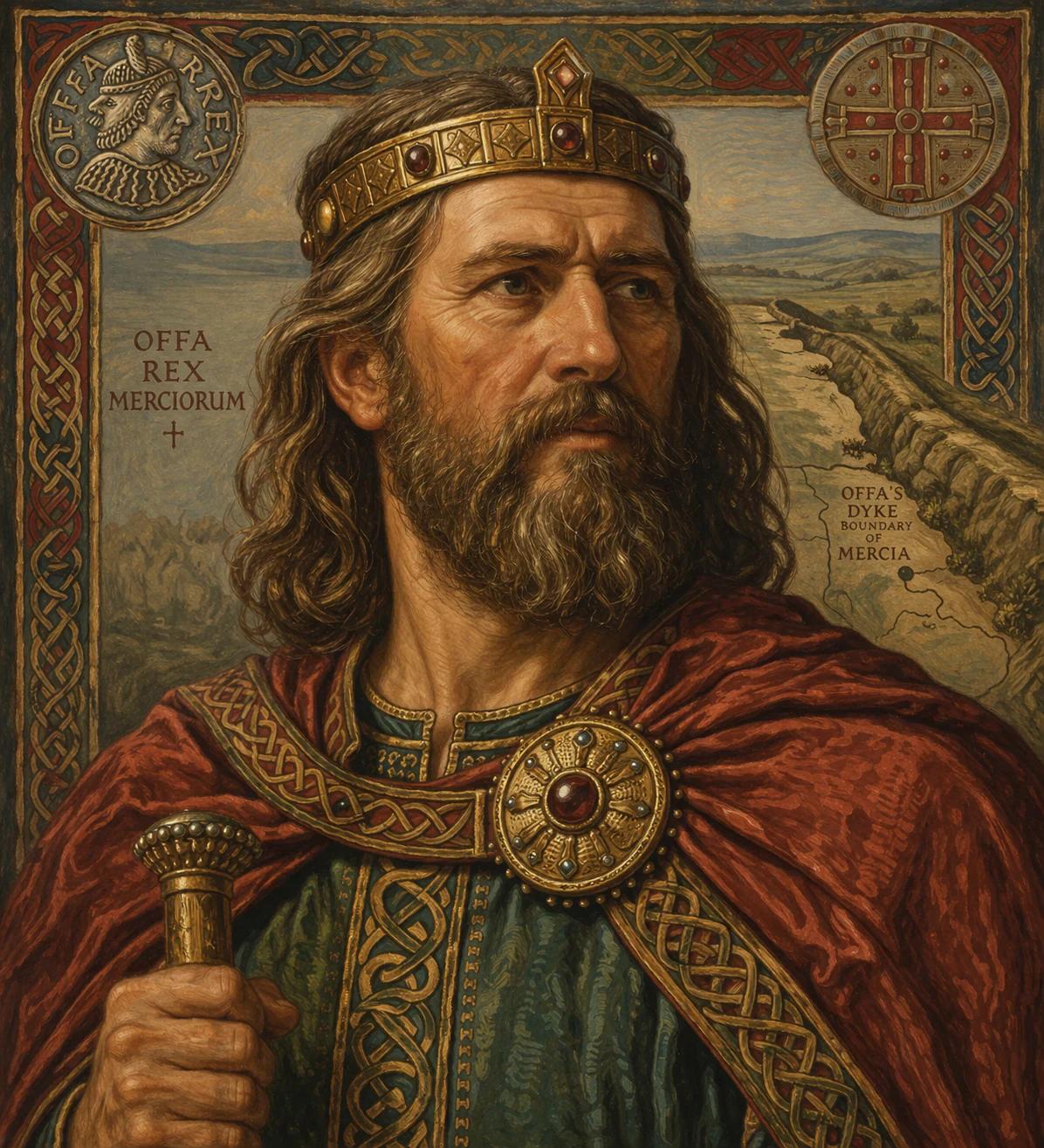
By the late eighth century, Offa of Mercia was the strongest ruler across much of southern England.
Before Offa, Anglo-Saxon England was split between several kingdoms. Power often depended on war, loyalty, and personal reputation.
Offa gained influence over other kingdoms and dealt with rulers overseas, including Charlemagne.
Offa's name is linked to a great earthwork along parts of the Welsh frontier. Surviving silver pennies bear his name.
The earthwork still marks the landscape. The coins show another way a king's authority could travel.
That pattern shaped later English kingship. Offa showed how military success, border rule, and trade could be turned into lasting authority.
793 CE
Step 8 of 10793 CEAccessible mode
The Raid on Lindisfarne
In 793, seaborne raiders attacked the monastery at . Letters from the time show how deeply the attack shocked some who heard about it.
Monasteries were not built like forts. They held books, silver, food, and holy objects, so they were rich and weak at the same time.
was also deeply respected. It was linked to Saint Cuthbert, so people saw it as a sacred place under God’s care.
The accounts describe killing and plunder. Much of what happened on the island that day went unrecorded.
The raid followed an earlier recorded clash on the south coast. It became the best-known early attack.
The raid became a symbol of a new age. It showed how exposed England was and foreshadowed centuries of Viking pressure and change.
865 CE
Step 9 of 10865 CEAccessible mode
The Great Heathen Army
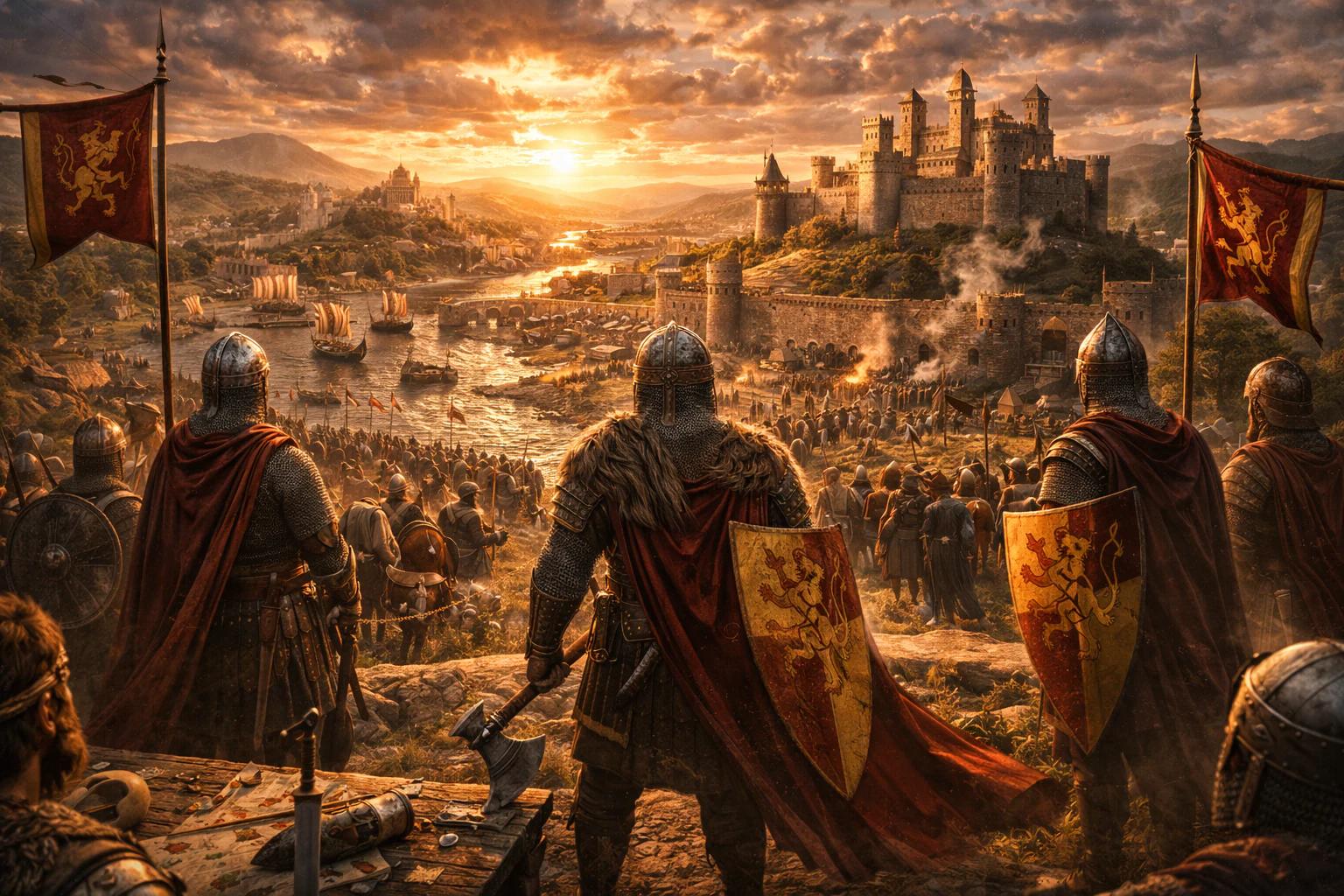
In 865, a large Scandinavian army arrived in . Over the following years it wintered in Britain, fought several kingdoms and seized territory.
Before this, Anglo-Saxon England was split into separate kingdoms like ,Mercia,, and . They shared language and religion, but each had its own rulers and rivalries.
The force moved between kingdoms. Its leaders made deals where they could and took land where they gained the upper hand.
The army took , overran and forced the Mercian king into exile. Northern and part of Mercia remained under local rulers, and resisted repeated attacks.
The wars sent some rulers into exile and left others negotiating for their lands. Some members of the army settled in the territories it had won.
The campaigns changed the balance of power and left and its rulers facing Scandinavian-held lands to the north and east.
878 CE
Step 10 of 10878 CEAccessible mode
Alfred the Great and the Shape of England
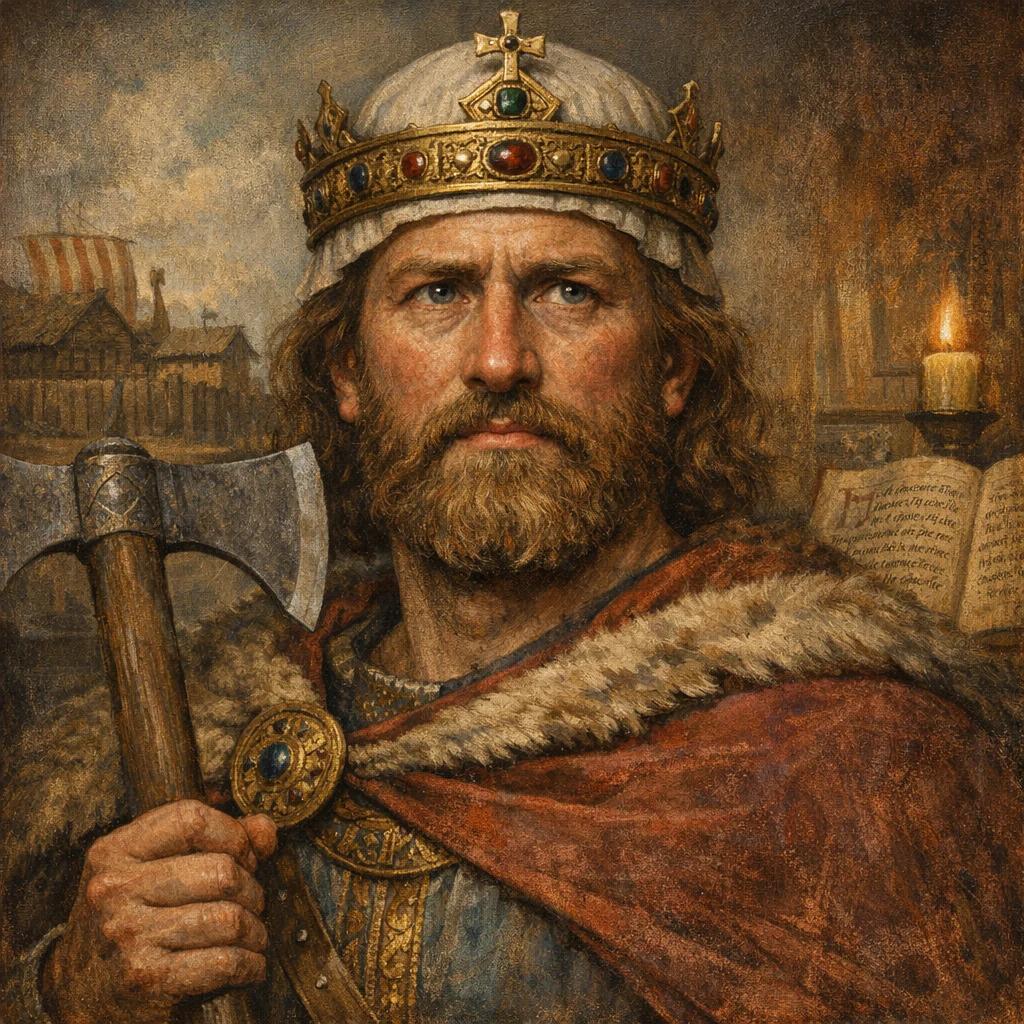
In 878, Guthrum's army drove Alfred into retreat. From the Somerset marshes, the king of gathered enough support to fight back.
Alfred's later defences relied on fortified places called burhs. The Chronicle also describes his defenders taking turns in the field.
Alfred defeated Guthrum at in 878, and Guthrum agreed to be baptised. A separate treaty, whose date is uncertain, later set terms for the border between their lands.
Fortified places gave people somewhere to turn during attacks. Some grew into centres of trade.Alfred also supported learning and the use of books in English.
Alfred kept independent. Later rulers extended their power, and his grandson Æthelstan took in 927. The English kingdom continued to change until William of Normandy defeated Harold at Hastings in 1066.
Keep exploring
Finished The Anglo-Saxons?
Choose the next story, follow a connected moment, or explore the people behind this story.