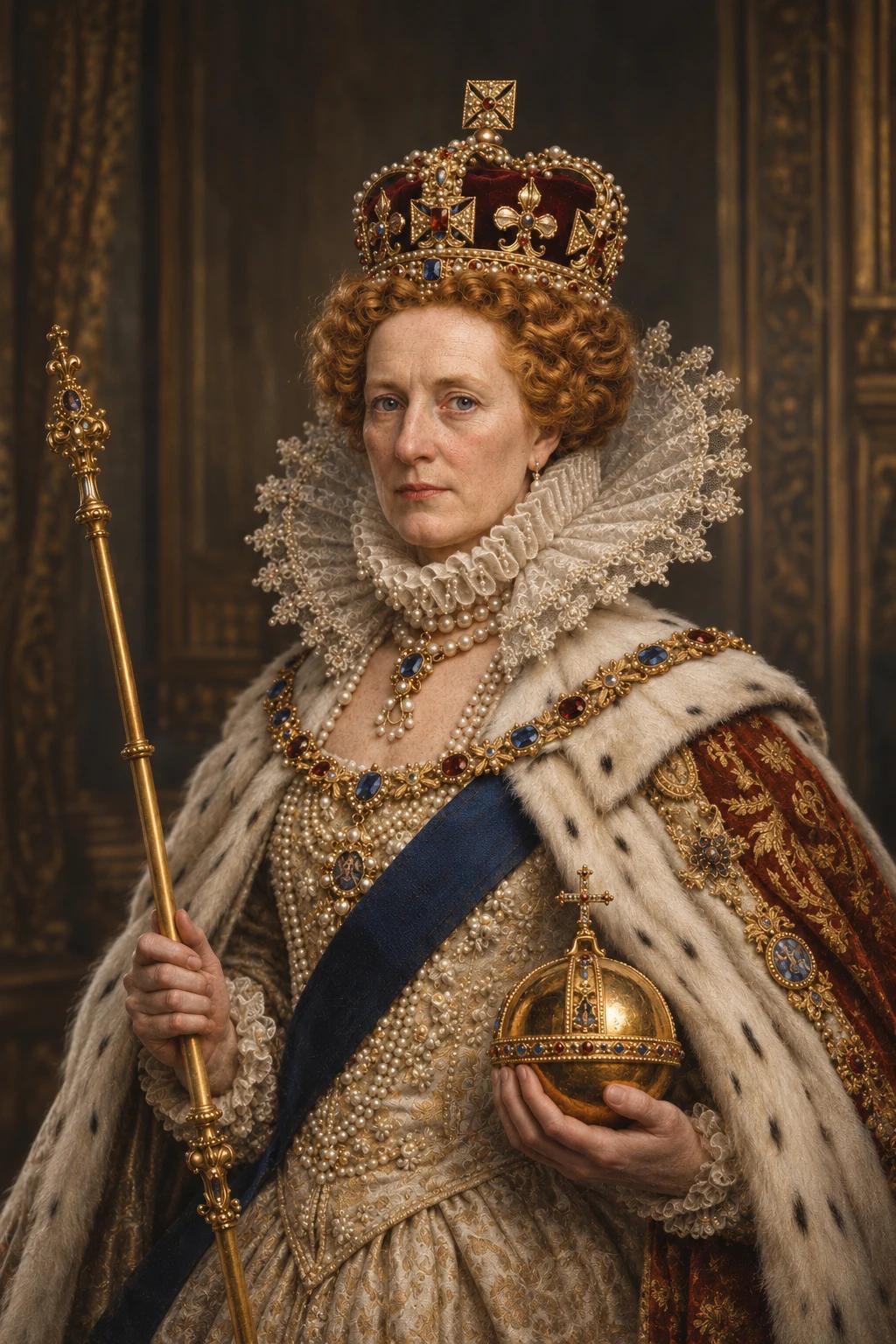
Queen Elizabeth I presiding over an Elizabethan court, evoking the reign's carefully cultivated royal splendour

Premium Story

The Elizabethan Age

Enter Elizabethan England, where royal power, theatre, sea power, faith and espionage shaped an age of ambition and insecurity.

11 chapters

Next

Content note

This story discusses war, violence, persecution, and death in an educational historical context.

Context

Introduction

Overview

Elizabeth I inherited a kingdom troubled by religious division and uncertain succession. Her long reign secured a Protestant monarchy and saw remarkable cultural achievement. Overseas ventures and war widened England's reach, while persecution, poverty and conflict in Ireland exposed the costs beneath its celebrated royal image.

Key forces

Illustrative reconstruction: Elizabeth I as a young queen aged 25, seated before courtiers at her accession in 1558.
1558 CE
Step 1 of 101558 CEAccessible mode

Elizabeth Takes the Throne

In November 1558, a twenty-five-year-old woman inherited the English throne — and a kingdom deep in trouble.

England had lurched through decades of religious upheaval. Henry VIII had broken from Rome. Edward VI's government imposed Protestant reforms. Mary I restored papal authority and had nearly three hundred Protestants burned for heresy.

When Mary died, she left behind debt, religious division, and a country that had lost the port of to France. Many doubted whether a woman could hold the kingdom together.

Elizabeth had already experienced the dangers of Tudor politics. Her mother had been executed, and Mary had imprisoned her in on suspicion of involvement in rebellion.

Her accession opened a new political chapter. England had no idea the reign would last nearly forty-five years and become one of the most celebrated in its history.

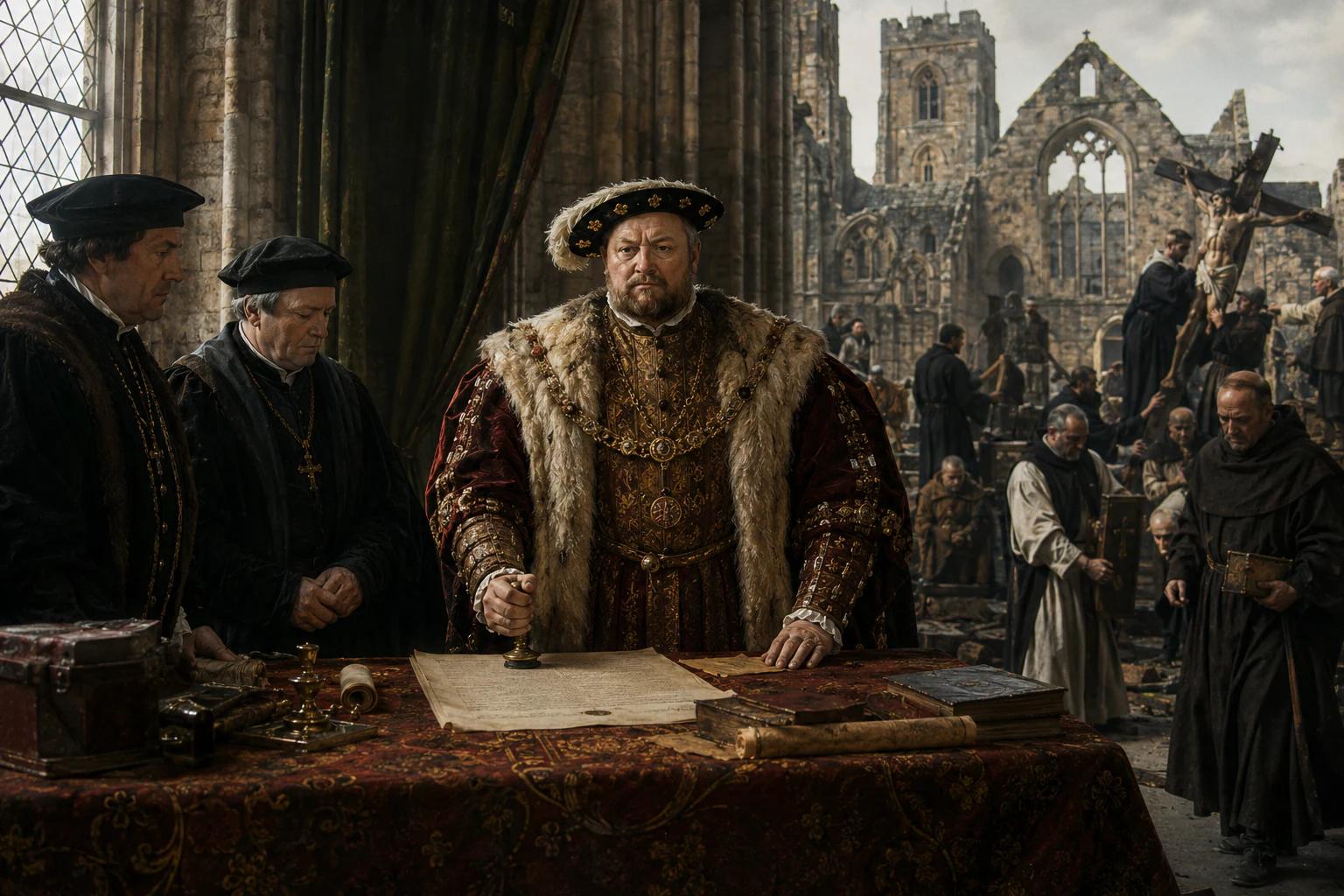
Illustrative reconstruction: Elizabeth I, aged 25 and wearing early-reign Tudor clothing, presenting settlement papers before clergy and councillors in 1559.
1559 CE
Step 2 of 101559 CEAccessible mode

The Religious Settlement

In 1559, Elizabeth tried to solve England's religious crisis by creating a church that most people could accept.

Successive rulers had changed the church's direction. Elizabeth chose Protestant rule, while keeping some familiar forms of church government and worship.

Parliament passed two acts. The Act of Supremacy made Elizabeth the Supreme Governor of the Church of England. The Act of Uniformity set out a single form of worship for everyone.

The settlement retained bishops and some traditional ceremonies. But it rejected papal authority, and the church's later Articles made its Protestant doctrine explicit.

Responses varied. Some Catholics conformed outwardly; others resisted. Reformers who wanted further change also criticised the church. The settlement endured under Elizabeth, sustained by persuasion, discipline and punishment.

Illustrative reconstruction: Elizabeth I, aged about 33, with advisers during an interpretive discussion of marriage and diplomacy in 1566.
1566 CE
Step 3 of 101566 CEAccessible mode

Survival Without Marriage

Elizabeth's advisers expected her to marry and have a child. She considered several matches, but never took a husband.

Parliament repeatedly asked Elizabeth to name a husband or at least an heir. They were terrified that if she died without a successor, England could fall back into civil war.

Elizabeth kept everyone guessing. She conducted lengthy negotiations with foreign princes — Philip of Spain, Archduke Charles of Austria — without ever agreeing to marry any of them.

Marriage negotiations became part of diplomacy. A possible match could promise an alliance, even when it never reached a wedding.

The risk remained. Elizabeth had relatives with competing claims, but no agreed successor. As the years passed without a marriage, the question of who would inherit grew harder to set aside.

PremiumFree preview: 3 of 10 chapters

Continue The Elizabethan Age

Sign up to a Premium account to read the remaining chapters of this story.

A paid Premium subscription also gives you full access to every other Premium story.
See Premium options

Coming next

  1. Chapter 4The Northern Rebellion
  2. Chapter 5The Excommunication Crisis
  3. Chapter 6England Looks Overseas

And 4 more chapters to follow.

Keep exploring

Follow the connected history

Explore closely connected stories and free figure profiles. Premium stories open with a public preview.

References

Sources and historical notes

Sources used to check this page, selected recommendations and historical notes.

Sources used

  1. Historic Royal Palaces, “The Elizabethan era: a golden age?,”

    Reign dates, royal image, cultural activity and overseas ventures. Interpretive overview, not proof of universal prosperity or toleration.

    Open source
  2. Historic Royal Palaces, “Elizabeth I, the Last Tudor,”

    Selected biographical sections: early danger, marriage pressure, Mary and Davison, late court losses, hardship and death. Private motives remain uncertain; its compressed claim that 1603 joined the kingdoms is qualified as a union of crowns.

    Open source
  3. Historic Royal Palaces — Lauren Shaw, “The death and succession of Elizabeth I,”

    Competing claims, Grey and Stuart lines, refusal to name an heir and proclamation in 1603. Does not establish a single inevitable successor.

    Open source
  4. University of Exeter — Stuart Successions Project, “Elizabeth I,”

    Marriage pressure, competing legal and hereditary claims, support for James and peaceful accession. Evaluative descriptions of Elizabeth are not adopted as facts.

    Open source
  5. UK Parliament, “The Reformation,”

    1559 royal supremacy, revised Prayer Book and subsequent restrictions. Public religious conformity should not be confused with liberty of conscience.

    Open source
  6. Church of England, “Articles of Religion,”

    Primary doctrinal text, especially Article XXVIII rejecting transubstantiation and describing reception through faith. Distinguishes Elizabethan doctrine from the later royal declaration prefixed to this edition.

    Open source
  7. K. J. Kesselring — Palgrave Macmillan, “The Northern Rebellion of 1569: Faith, Politics and Protest in Elizabethan England,”

    Publisher overview consulted, not the full book. Supports attention to rank-and-file religious motivation and violent aftermath rather than an exclusively aristocratic explanation.

    Open source
  8. Wilfred Hammond — Boydell & Brewer / Cambridge Core, “The Rebellion of the Northern Earls 1569–70,”

    Public chapter summary consulted, not full chapter. Identifies the two earls, Catholic gentry, devotional banner and absence of a united northern or Catholic front.

    Open source
  9. Siiri Tenno — Durham University, “Religious Deviance in the Elizabethan Diocese of Durham (MA thesis, 2009),”

    Selected introduction and chapter II passages, especially printed pp.29–30 and 48. Parish religion and restoration of Mass; execution estimates vary and do not establish one precise total. Not a full-thesis review.

    Open source
  10. Pius V — Papal Encyclicals Online, “Regnans in Excelsis (1570),”

    English translation of the primary bull, especially clauses 3–5 and closing date, 25 February 1570. Polemical allegations are evidence of papal claims, not neutral findings about Elizabeth.

    Open source
  11. Hanover Historical Texts Project, “Act Against Jesuits and Seminarists (1585),”

    Primary statute transcription from Gee and Hardy, pp.485–492. Defines affected clergy, the June 1559 ordination threshold, entry or remaining, exceptions and penalties for knowingly sheltering them. Its preamble is the government’s accusation, not proof against every priest.

    Open source
  12. National Museums Scotland, “Life and deathline of Mary, Queen of Scots,”

    Selected timeline entries: Francis II, Darnley, Bothwell, abdication, flight to England, Babington correspondence, trial and execution. Avoids adopting the site’s exact Langside day or categorical view of disputed correspondence.

    Open source
  13. U.S. National Park Service, “Sir Francis Drake,”

    Atlantic slave-trading voyages with Hawkins; circumnavigation 1577–1580, knighthood 1581, and failed expedition of 1589. Approximate birth c.1540. Triumphalist claims of immediate English global supremacy and disputed ship-loss totals are not adopted.

    Open source
  14. U.S. National Park Service — Fort Raleigh, “1590 Rescue Voyage,”

    White’s return, CROATOAN inscription, failure to follow the clue and Jamestown in 1607. Supports uncertain fate rather than disappearance without trace; its claims of an instant global power shift in 1588 are not adopted.

    Open source
  15. Royal Museums Greenwich, “Research guide P3: Charts of the Spanish Armada by Robert Adams in the Museum,”

    Selected campaign introduction and chart descriptions: preparations before 1587, Lisbon, Plymouth and Downs squadrons, Howard and Drake, Channel and northern retreat. Does not support a Gibraltar passage or Portsmouth departure. Exact dates can differ by calendar; contested fleet-loss totals omitted.

    Open source
  16. UK Parliament — Armada Tapestries, “English Fireships Dislodge the Spanish Fleet Before Calais,”

    Institutional presentation of John Pine’s 1739 account. Calais anchorage, fireships, scattered fleet and ensuing battle; a later account, not an eyewitness transcript.

    Open source
  17. Royal Museums Greenwich, “Launch of fireships against the Spanish Armada, 7 August 1588,”

    Catalogue interpretation of a c.1590 Flemish painting. Distinguishes campaign sequence from imagined pictorial action and supports fireships before the retreat. Date uses a different calendar from conventional English July dates.

    Open source
  18. Folger Shakespeare Library, “Shakespeare’s theater,”

    Performance settings, Theatre 1576, company by 1594, Globe 1599 and admission differences. These commercial playhouses did not originate all English drama.

    Open source
  19. Barbara Mowat and Paul Werstine — Folger Shakespeare Library, “Shakespeare’s Life: From the Folger Shakespeare Editions,”

    Selected career and London sections: 1564–1616, theatre reopening in 1594, 1590s writing and work continuing under James. Distinguishes documentary evidence from attractive biographical legends.

    Open source
  20. Trinity College Dublin Library, “In Tune: Early Music Treasures,”

    Collection entries for Tallis and Byrd’s 1575 Cantiones: printing patent, royal dedication, commercial difficulty and manuscript additions. Corrects an exclusively manuscript account of circulation.

    Open source
  21. Ruth Canning — Boydell & Brewer / JSTOR, “The Old English in Early Modern Ireland: The Palesmen and the Nine Years’ War, 1594–1603,”

    Public chapter extracts, particularly socio-economic impact and epilogue, consulted rather than full book. Supports war’s wider burdens, diverse Catholic loyalties and O’Neill’s submission on 30 March 1603, after Elizabeth’s death.

    Open source
  22. Government of Gibraltar, “Geography,”

    Official approximate latitude 36°07′N and longitude 5°21′W used to relocate the misplaced pin to 36.117, -5.350. Modern geographic orientation only; not evidence of an Armada passage.

    Open source
  23. Royal Shakespeare Company, “Meet the contemporaries,”

    Marlowe section: 1564–1593, Tamburlaine, Doctor Faustus and Edward II. Speculative accounts of intelligence work or a government assassination are not adopted.

    Open source
  24. English Heritage, “Tudors: Religion,”

    Religious changes under Henry, Edward, Mary and Elizabeth, nearly 300 Marian burnings, parish transformations and religious drama. Its generalisation about early private tolerance is qualified against statutory conformity and later persecution.

    Open source
  25. UK Parliament, “Persecution,”

    Seventeenth-century dismantling of episcopal church government and subsequent restoration. Corrects the claim that the 1559 settlement continued uninterrupted; not an assertion that religion alone caused civil war.

    Open source
  26. The British Library, “Showing Elizabeth I in a new light,” Open source
  27. Royal Museums Greenwich, “Richard Hakluyt: Elizabethan voyages and exploration,” Open source
  28. British History Online, “Primary sources for early modern Britain,” Open source

Additional sources and notes

Loading reviewed claim sources...

Our editorial approach · Report a historical error

A monthly route through history

Find out first about the latest published stories, feature notes and occasional Premium offers in one monthly email.