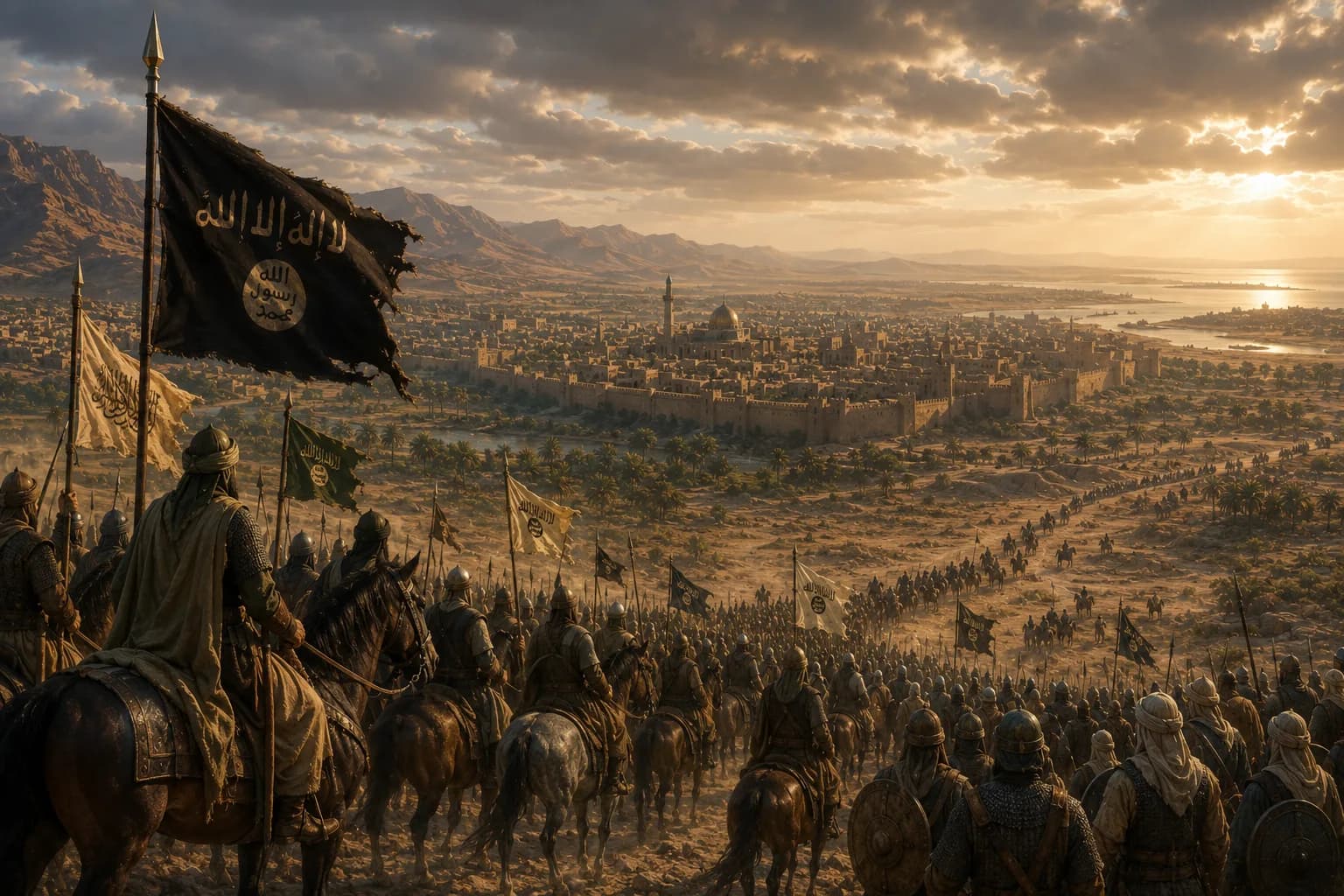
Accessible gives a lighter overview. Deep Dive tells the fuller story.
Quick Answers
What was the Abbasid Golden Age?
The Abbasid Golden Age was a period of intense intellectual, cultural and economic growth under Abbasid rule, especially from the eighth to eleventh centuries. Centred on , it joined translation, scholarship, trade, medicine, mathematics, astronomy, philosophy and literature into a wider Islamic civilisation.
At a glance
The Abbasids defeated the Umayyads across most of the caliphate in 750.
was founded by Caliphal-Mansur in 762 and became the Abbasid capital.
is associated with a court book collection. Many patrons and scholars supported the wider translation movement.
Arabic became a major language of scholarship across mathematics, astronomy, medicine and philosophy.
The Mongol conquest of in 1258 ended Abbasid rule in the city, but Abbasid intellectual legacies endured.
Common questions
Why was Baghdad important?
stood near major river, land and trade routes, close to older Persian and Mesopotamian centres of administration. Its planned foundation made it the political capital of the Abbasid state, and its markets, libraries, courts and schools helped it become a major centre of learning.
What was the House of Wisdom?
, or , is associated with an Abbasid court library or book collection. Its exact activities are uncertain. A wider network of patrons and scholars carried out the translation movement.
Did the Golden Age end in 1258?
The conquest in 1258 ended Abbasid rule in and caused extensive loss of life and damage. The date is a political endpoint. Readers, libraries and scholars remained active in under Mongol rule and elsewhere.
Context
Introduction
Overview
When the Abbasids took power in the eighth century, they shifted the centre of the caliphate eastward and founded . The city became a meeting place for merchants, officials and scholars who drew on knowledge from across the connected medieval world. Even as Abbasid political authority weakened, the learning and culture fostered under its rule travelled far beyond the capital.
Key forces
The Abbasids defeated the Umayyads in 750 and shifted the centre of the caliphate eastwards.
, founded in 762, became a political, commercial and intellectual capital.
is associated with a court book collection. Many patrons and scholars supported the wider translation movement.
Abbasid scholarship turned inherited learning into new work in mathematics, astronomy, medicine and philosophy.
750 CE
Step 1 of 10750 CEAccessible mode
The Abbasid Revolution
In 750, the Abbasids defeated the Umayyads and took power in most of the caliphate. A branch of the Umayyad family later established its own rule in al-Andalus.
The Umayyads had ruled from Damascus since the seventh century. Their empire was vast, but not everyone accepted the way power was held.
Opposition took different forms. Some non-Arab Muslims resented unequal treatment. Other supporters rallied around the Prophet’s family or had grievances over taxes and provincial rule.
The Abbasids built support in the east, especially in Khurasan. Their movement joined religious hope, political grievance and military organisation.
After victory, the Abbasids claimed legitimacy through descent from al-Abbas, Muhammad's uncle. They kept the caliphate, but gave it a new centre of gravity.
The new court drew heavily on Iraq and the eastern provinces. Officials, merchants and scholars worked within networks that crossed linguistic and regional boundaries.
762 CE
Step 2 of 10762 CEAccessible mode
The Founding of Baghdad
In 762, Caliphal-Mansur founded as the new capital of the Abbasid world.
The choice was strategic. stood on the Tigris, close to canals, farmland, river transport and overland routes that linked Iraq with Iran, Syria, Arabia and Central Asia.
It was also near older centres of power. The region had long experience of empire, administration and urban life, including the Sasanian world that had once ruled from nearby Ctesiphon.
At the heart of al-Mansur’s planned Round City stood the palace and mosque. Walls and gates controlled entry. The wider city soon grew beyond them.
The city quickly became more than a palace. Officials, soldiers, artisans, merchants, scholars and travellers gathered there.
became a great market and seat of government. The court later moved to Samarra from 836 to 892, while remained a major city.
830 CE
Step 3 of 10830 CEAccessible mode
The Rise of the House of Wisdom
Under al-Ma’mun, the Abbasid court supported books and scholarship. is the name most often linked with that age of learning.
means . Medieval references link it to a court collection of books, but give only a partial picture of its work.
Al-Ma’mun ruled from 813 to 833 and supported learned work, including astronomy. Translators and scholars also worked for other patrons in and beyond.
Knowledge came from many directions. Greek philosophy and science, Persian literature and statecraft, Indian mathematics and astronomy, and Syriac Christian scholarship all helped shape Abbasid learning.
The institution was not the only centre of learning. Mosques, private libraries, hospitals, courts and scholars' homes also mattered.
is often remembered as a great centre of translation. The evidence for the translation movement is much wider than the surviving evidence for the institution itself.
PremiumFree preview: 3 of 10 chapters
Continue The Abbasid Golden Age
Sign up to a Premium account to read the remaining chapters of this story.
A paid Premium subscription also gives you full access to every other Premium story.