← People

Lyndon B Johnson

Lyndon B Johnson was the 36th U.S. president, a master legislator whose Great Society, Civil Rights Act, Voting Rights Act and Medicare transformed America, while Vietnam shattered his presidency.

Born
1908 CE
Died
1973 CE
Role
36th President of the United States
Also known as
Lyndon B. Johnson, LBJ

36th President of the United States (1908–1973)

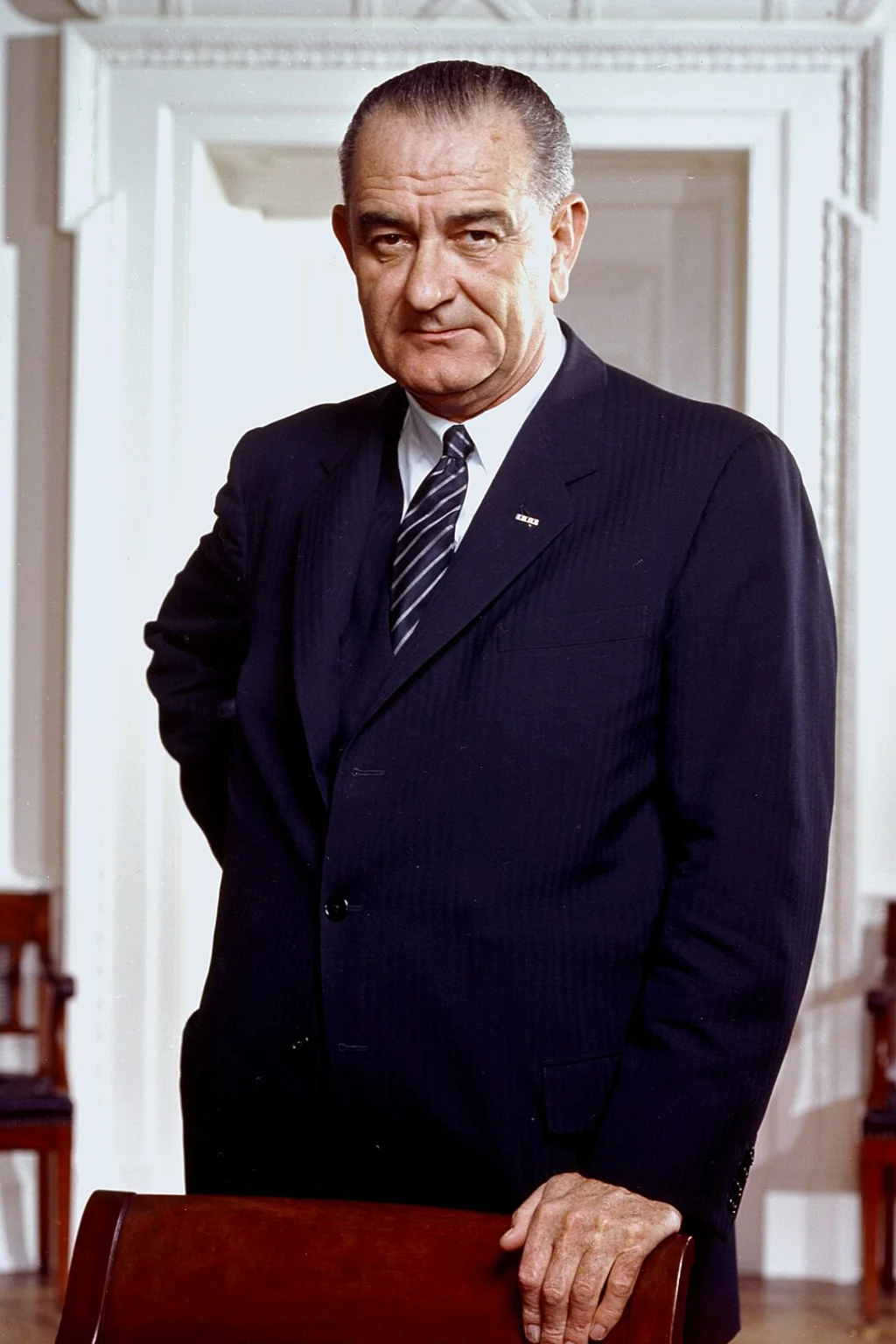
Portrait photograph of Lyndon B Johnson
Historical photograph

A real historical or editorial image is used here. Source, licence and transformation details are publicly recorded. Image policy Attribution

Life Journey

A forceful rise through power, reform and controversy

Follow the key events and turning points in this life story.

Complete chronology

1908–1930

Texas roots

Lyndon Baines Johnson was born in 1908 near Stonewall, Texas, into a family that mixed political memory with financial insecurity. His father had served in the Texas legislature, but the Johnson household knew debt, hard work and social vulnerability. The Hill Country gave Johnson a lifelong language of rural hardship: bad roads, limited electricity, poor schools and families dependent on weather and credit. As a young teacher in Cotulla, he worked with Mexican American children whose poverty left a deep impression on him. Johnson's later War on Poverty was not only abstract liberal policy. It grew from a politician who had seen how geography, class and race could narrow a child's future before adulthood began.


1930–1948

Early political climb

Johnson's political climb began with relentless work as a congressional aide and then as a New Deal Democrat from Texas. He ran for Congress in 1937 and won, presenting himself as a young ally of Franklin D. Roosevelt. The New Deal mattered to him practically as much as ideologically. It brought electricity, jobs, public works and federal attention to places that had felt ignored. Johnson learned that politics was not merely speechmaking; it was delivery. He cultivated patrons, remembered favours, mastered detail and turned personal relationships into durable leverage. His ambition was enormous, but it was attached to a clear lesson: government could change material life when someone knew how to move it.

1949–1960

Senate leadership

Johnson entered the Senate in 1949 after a disputed 1948 election and rose with astonishing speed. As Senate majority leader from 1955, he became one of the most powerful legislators in American history. His method was personal, physical and procedural: flattery, threat, information, timing, committee assignments and the famous close-range persuasion later called the Johnson Treatment. He knew what senators wanted, feared and owed. He also understood the Senate's conservative bottlenecks, especially around civil rights. The Civil Rights Act of 1957 was limited, but Johnson's handling of it showed his central talent: moving a bill through a chamber designed to stop difficult bills.

1961–1963

Vice presidency

Johnson accepted the vice presidency in 1960 after losing the Democratic nomination to John F. Kennedy. The move gave Kennedy southern balance and legislative credibility, but it cost Johnson the daily power he had held in the Senate. As vice president, he chaired councils, travelled abroad and advised on congressional strategy, yet he often felt diminished by Kennedy's inner circle. The office exposed the awkwardness of Johnson's political identity: too powerful to be decorative, not powerful enough to command. Still, he remained close to the machinery of government and to the unresolved domestic agenda Kennedy had struggled to pass.

1963

Assuming presidency

Johnson took the presidential oath aboard Air Force One on 22 November 1963 after Kennedy was assassinated in Dallas. The country was stunned, and Johnson understood that legitimacy had to be built quickly. He kept Kennedy's cabinet, reassured allies and framed major legislation as the fallen president's unfinished work. But Johnson was not merely preserving another man's programme. He saw an opening that his Senate experience had prepared him to use. By combining national mourning with hard legislative calculation, he moved civil rights, tax cuts and anti-poverty measures toward the centre of his presidency.

1964–1966

Great Society reforms

The Great Society was Johnson at full force. After winning a landslide in 1964, he used huge Democratic majorities and his own legislative mastery to pass the Civil Rights Act of 1964, Voting Rights Act of 1965, Medicare and Medicaid, federal aid to education, immigration reform, public broadcasting, consumer protections, environmental measures and anti-poverty programmes. These laws changed American life. They weakened legal segregation, expanded access to healthcare, opened political participation and gave the federal government a larger role in social welfare. The programme also produced lasting arguments about bureaucracy, dependency, local control and cost. But as a burst of domestic lawmaking, Johnson's achievement remains extraordinary.

1964–1968

Vietnam escalation

Vietnam destroyed the political world Johnson was trying to build. He feared being blamed for losing South Vietnam, believed containment still mattered in the Cold War, and worried that weakness abroad would endanger reform at home. After the Gulf of Tonkin incident in 1964, Congress granted broad authority, and Johnson steadily escalated bombing and ground troop deployments. The war's human cost rose while victory remained elusive. Official optimism clashed with television images, casualty lists and the experience of soldiers. Anti-war protest grew across campuses, churches, civil rights circles and parts of Congress. Johnson's tragedy was not ignorance alone; it was the refusal to admit that the means chosen could not deliver the political end promised.

1968

Decision not to run

The Tet Offensive of 1968 shocked the American public. Militarily, communist forces suffered heavy losses, but politically Tet shattered the credibility of official claims that success was near. Johnson faced a Democratic Party breaking apart, a strong anti-war challenge from Eugene McCarthy, Robert Kennedy's entry into the race, and urban unrest linked to deeper racial and economic frustrations. On 31 March 1968, he announced a partial bombing halt and stunned viewers by declaring he would not seek reelection. The decision was both statesmanlike and desperate. It acknowledged that his presidency had become consumed by Vietnam, even as the country he wanted to reform was still burning with unfinished questions.

1969–1973

Legacy and reflection

Johnson left office in January 1969 exhausted, unpopular and wounded by the war. He returned to the LBJ Ranch in Texas, watched Vietnam continue under Richard Nixon, and died of a heart attack in 1973. His legacy remains a study in contradiction. On domestic policy, few presidents changed law and daily life so quickly: civil rights, voting rights, healthcare, education and immigration all bear his mark. On Vietnam, he expanded a war that cost tens of thousands of American lives and vastly more Vietnamese, Cambodian and Laotian lives, while eroding public trust in government. To ask why Lyndon B Johnson was important is to confront the possibility that transformative reform and catastrophic judgement can belong to the same presidency.

Continue in context

Connected stories

Move from the profile into the wider events and settings this figure belongs to.

More connected stories

American Presidents lineage
Lineage47 presidents
American Presidents
1789 CE–present

The succession of American presidents from George Washington to today.

View lineage

Keep exploring

Content note

This profile is written for educational use and connects to related Stories of History pages. The main portrait uses a real historical or editorial image, with source and licence details recorded for attribution review. Image policy Image attribution

References

Sources and historical notes

Sources used to check this page, selected recommendations and historical notes.

Sources used

  1. Miller Center, University of Virginia, “Lyndon B. Johnson: Life in Brief,”

    Johnson’s congressional career, Great Society and escalation of the Vietnam War.

    Open source
  2. U.S. National Archives, “Civil Rights Act (1964),”

    The landmark civil rights legislation signed by Johnson, including provisions on public accommodation and employment.

    Open source
  3. Lyndon B. Johnson Presidential Library, “Lyndon B. Johnson,”

    Johnson’s rise to office and legislative record, including voting rights and Medicare.

    Open source

Additional sources and notes

Loading reviewed claim sources...

Our editorial approach · Report a historical error

A monthly route through history

Find out first about the latest published stories, feature notes and occasional Premium offers in one monthly email.