← People

Euclid

Euclid was a Greek mathematician active in Alexandria around 300 BC. His Elements organized geometry and number theory into an axiomatic system that became one of the most influential textbooks in world history.

Born
c. 325 BCE
Died
c. 265 BCE
Role
Mathematician
Also known as
Euclid of Alexandria
Region
Egypt, Greek world, Alexandria

Greek mathematician (fl. c. 300 BC)

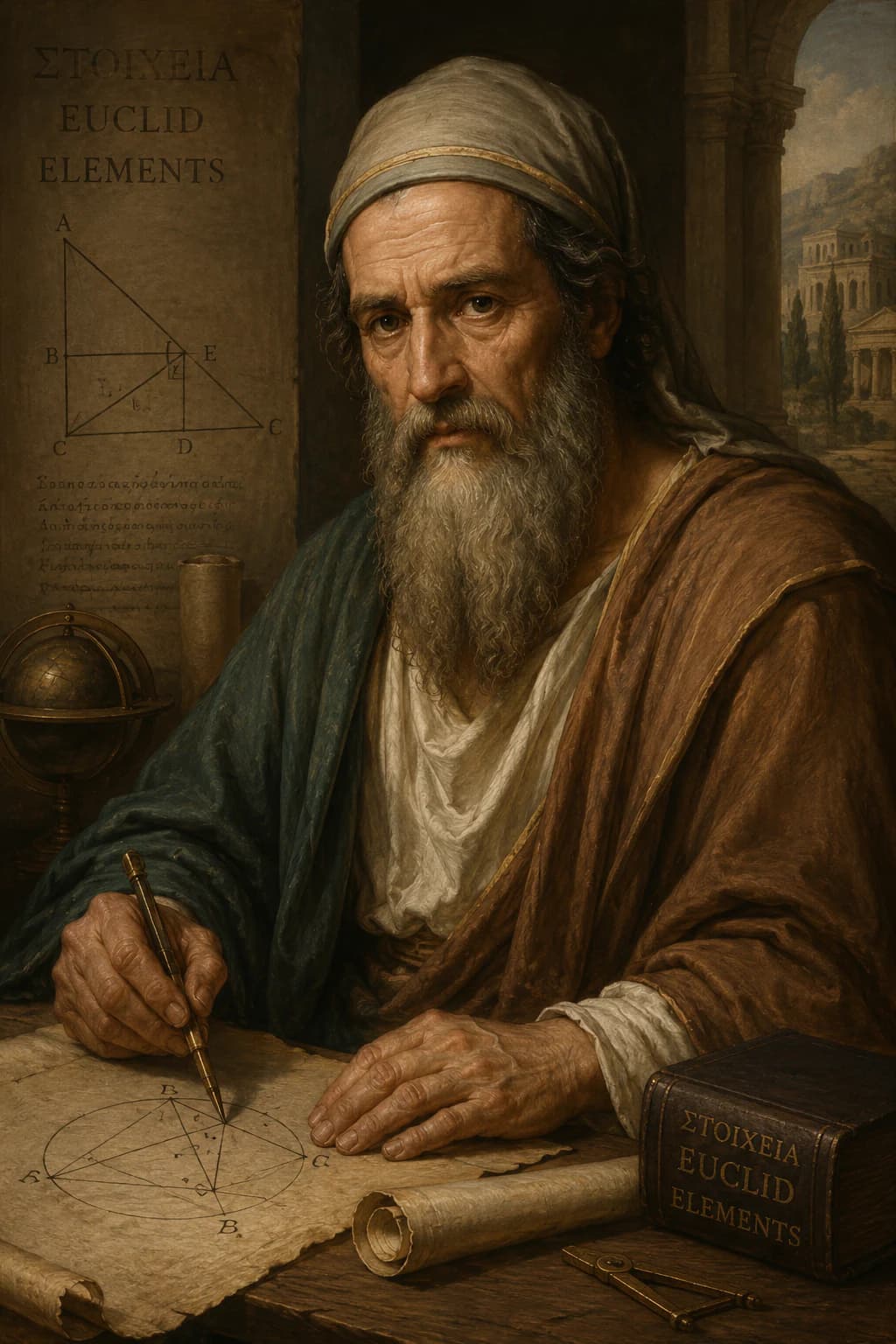
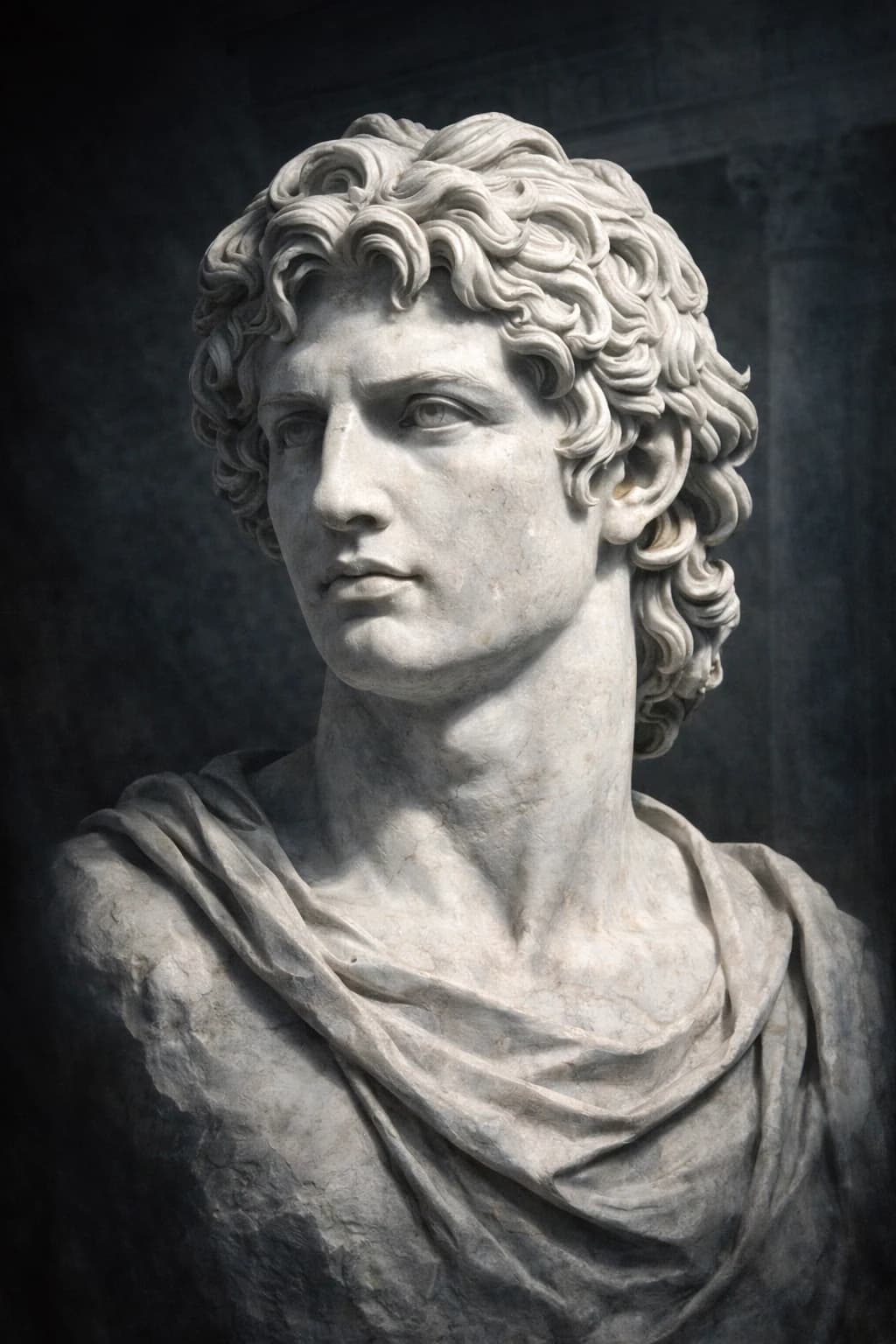
AI-generated portrait of Euclid with geometric diagrams
AI-assisted historical reconstruction

An illustrative reconstruction based on historical context. It is not a photograph or documentary likeness. Image policy

Life Journey

The architect of geometry

Follow Euclid through the Alexandrian world of proof, teaching, and mathematical order.

Complete chronology

c. 300 BC

Alexandrian scholar

Very little is known about Euclid's personal life, but he is closely associated with Alexandria in Egypt around 300 BC. This was the world of the early Ptolemies, who sponsored scholarship, libraries, and learned communities. Euclid's importance does not depend on biography. It rests on the mathematical tradition he organized and transmitted with unusual clarity.

c. 300 BC

The Elements

The Elements did not invent all the mathematics it contains. Its power was organization. Euclid began with definitions, postulates, and common notions, then used them to prove propositions step by step. Geometry became a disciplined system in which conclusions depended on stated assumptions and logical demonstration. That model shaped not only mathematics but ideas about what rigorous knowledge should look like.

Hellenistic period

Teaching proof

The Elements became a teaching text because it trained readers to think in sequences. A student did not merely memorize facts about triangles, circles, and ratios; they learned how one statement could support the next. This made Euclid a model of intellectual discipline. Later scholars translated, commented on, revised, and taught the text across Greek, Arabic, Latin, and modern scientific traditions.

After antiquity

Long after Alexandria

Euclid's influence lasted because the Elements offered both content and method. It shaped Islamic mathematics, medieval European learning, Renaissance education, and early modern science. Non-Euclidean geometry eventually showed that Euclid's system was not the only possible geometry, but that did not diminish his achievement. It clarified it. Euclid had shown how a mathematical world could be built from explicit foundations.

Continue in context

Connected stories

Move from the profile into the wider events and settings this figure belongs to.

Tertiary paths

Content note

This profile is written for educational use and connects to related Stories of History pages. The main portrait is an AI-assisted historical reconstruction, included as an illustrative aid rather than documentary evidence. Image policy

References

Sources & Further Reading

Reliable reference works, archives and reading paths connected to this profile.

Further reading

  1. Encyclopaedia Britannica, “Search results for Euclid,” accessed June 2026.Open source
  2. WorldCat, “Books and library holdings for Euclid,” accessed June 2026.Open source

Primary sources

  1. Library of Congress, “Search results for Euclid,” accessed June 2026.Open source

Reviewed claim sources

Loading reviewed claim sources...

A monthly route through history

Find out first about the latest published stories, feature notes and occasional Premium offers in one monthly email.