This story discusses slavery, exploitation, racial persecution, and violence in an educational historical context.
Reading mode
Accessible gives a lighter overview. Deep Dive tells the fuller story.
Quick Answers
What was the American Civil War?
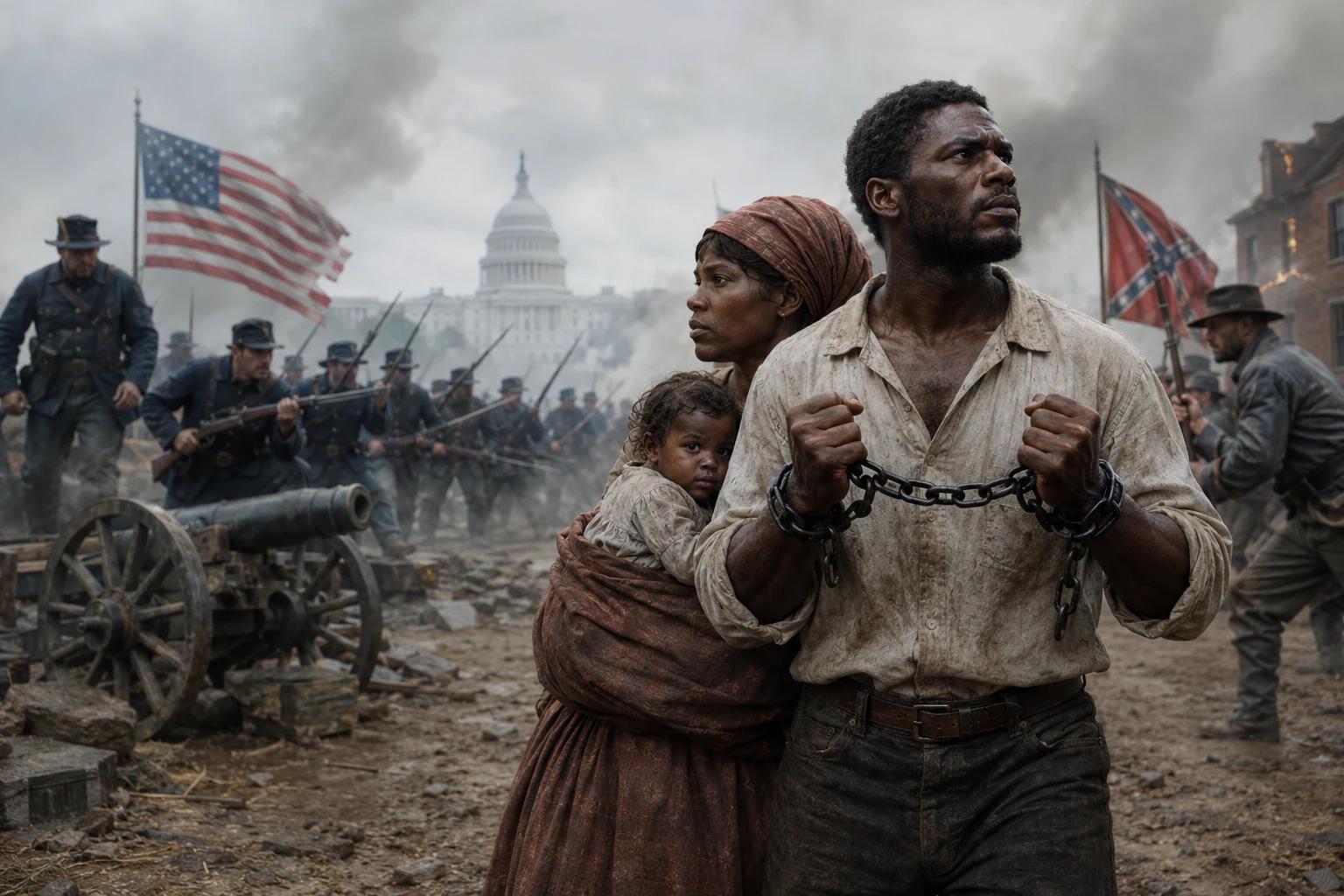
The American Civil War was fought from 1861 to 1865 between the United States and the Confederate states that seceded to defend slavery and regional power. The war preserved the Union and ended slavery, but left unresolved struggles over citizenship, race, and reconstruction.
At a glance
Story coverage: 1793 to 1877; the Civil War itself lasted from 1861 to 1865.
The American Civil War determined the survival of the Union and led to the abolition of slavery, fundamentally reshaping the United States.
Slavery was the central cause of the sectional crisis that led to civil war.
Westward expansion repeatedly reopened the question of slavery's future.
Common questions
What caused the American Civil War?
Slavery was the central cause of the sectional crisis. Disputes over slavery's expansion, political power, states rights arguments, and Lincoln's election led southern states to secede.
When was the American Civil War?
The war lasted from April 1861, when Confederate forces fired on , to 1865, when Confederate armies surrendered and slavery was abolished by the Thirteenth Amendment.
Reconstruction tried to rebuild the South and define freedom for formerly enslaved people. It produced constitutional change but also violent resistance and a long struggle over civil rights.
Context
Introduction
Overview
The American Civil War was fought from 1861 to 1865 between the United States and the Confederate states that seceded to defend slavery and regional power. What began as a war over union became a revolutionary conflict over emancipation and the future of American democracy.Union victory destroyed slavery, but Reconstruction and its failure left unresolved struggles over citizenship, race, federal power, and freedom.
Key forces
Slavery was the central cause of the sectional crisis that led to civil war.
Westward expansion repeatedly reopened the question of slavery's future.
Secession followed Lincoln's election and the collapse of political compromise.
The war became a struggle for emancipation as well as Union victory.
1793 CE
Step 1 of 101793 CEAccessible mode
The Cotton Kingdom
In 1793, one invention changed . It made cotton king — and made slavery the engine of a nation's wealth.
Before Eli Whitney's cotton gin, growing short-staple cotton was slow and expensive. After it, the crop could be processed quickly and at vast scale. Plantations spread rapidly across the South.
More cotton meant more enslaved labour. Planters pushed into new territory, buying thousands of men, women, and children to work the land. By 1860, nearly four million people were held in bondage.
Cotton became the country's most valuable export. Northern banks financed Southern plantations. mills processed Southern cotton. The whole national economy was entangled with slavery.
Some Americans had hoped slavery might gradually fade. After the cotton gin, it expanded rapidly. Wealthy planters built their politics around protecting it.
This was one turning point on the road to civil war. As cotton strengthened slavery's hold on Southern wealth, slaveholding leaders treated any threat to it as a threat to their own survival.
1820 CE
Step 2 of 101820 CEAccessible mode
The Missouri Compromise
In 1820, a crisis over revealed something important: the United States could not agree on whether slavery should spread.
applied to join the Union as a slave state. Northerners objected. If entered, slavery would grow stronger in a country already divided.
Henry Clay helped broker a deal. entered as a free state in 1820; followed as a slave state in 1821, restoring the balance in the Senate.Slavery was barred north of latitude 36°30' in the remaining Louisiana Purchase territory, with excepted.
Both sides accepted the deal, but neither was satisfied. Thomas Jefferson called the crisis a fire bell in the night — a warning of something dangerous that could not be put off forever.
The Missouri Compromise did not solve the problem. It postponed it. Its territorial restriction lasted until Congress repealed it in 1854 — thirty-four years after the settlement.
1848 CE
Step 3 of 101848 CEAccessible mode
The Mexican Cession
In 1848, the United States won a war against Mexico and gained enormous new territories. An argument already raging in Congress became more urgent: would slavery follow?
The Mexican-American War ended with the United States taking land that would become ,, and much of the American West. It was a massive prize — and a political problem.
In 1846, Congressman David Wilmot had proposed banning slavery from territory acquired from Mexico. Southern opponents blocked the proposal. If slavery could not expand into new land, Southern power in Congress would eventually shrink.
A Free-Soil movement grew in the North. Many Northerners did not want slavery in the new West — though not always for moral reasons. They wanted free white settlers to work the land.
The Compromise of 1850 patched things up temporarily. But the deeper argument remained. Every new territory now carried the same question inside it — and no one had a permanent answer.
PremiumFree preview: 3 of 10 chapters
Continue The American Civil War and the Abolition of Slavery
Sign up to a Premium account to read the remaining chapters of this story.
A paid Premium subscription also gives you full access to every other Premium story.