← People

Karl Liebknecht

Karl Liebknecht was a German socialist revolutionary, anti-war campaigner, Spartacist League leader, and co-founder of the Communist Party of Germany. He was murdered during the German Revolution in January 1919.

Born
1871 CE
Died
1919 CE
Role
German socialist revolutionary and Spartacist leader
Full name
Karl Paul August Friedrich Liebknecht
Also known as
Liebknecht

German socialist revolutionary (1871-1919)

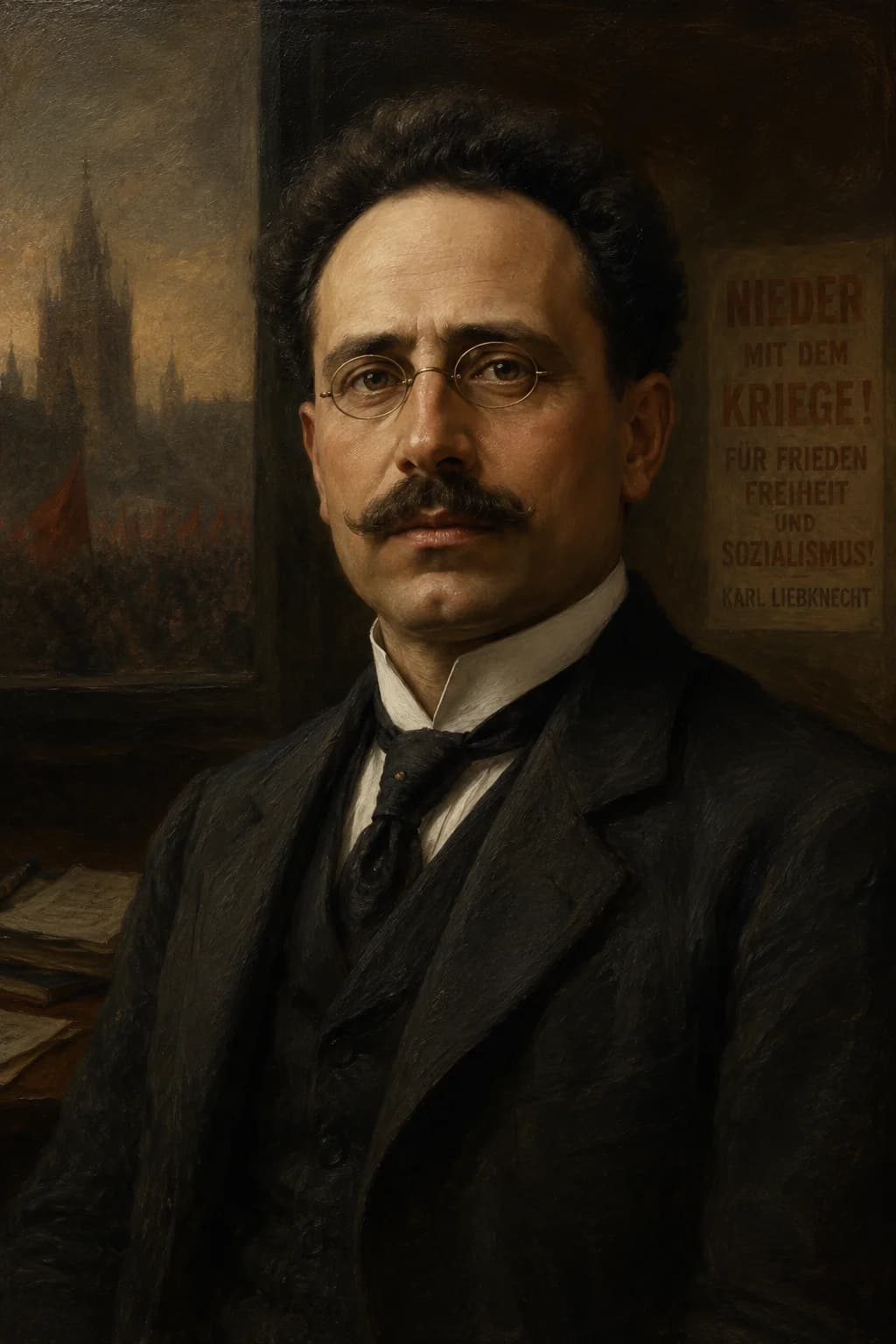
AI-generated portrait of Karl Liebknecht
AI-assisted historical reconstruction

An illustrative reconstruction based on historical context. It is not a photograph or documentary likeness. Image policy

Life Journey

Why Karl Liebknecht matters

Follow the story in a more continuous narrative, with a reading mode that matches how much depth you want.

Complete chronology

1871

Born into socialism

Karl Liebknecht was born in Leipzig on 13 August 1871, the same year the German Empire was created. His father, Wilhelm Liebknecht, was one of the founders of the Social Democratic Party of Germany, so Karl grew up with socialist politics not as an abstract theory but as a family inheritance. He studied law and economics, became a lawyer, and used that training to defend political activists and workers. That background shaped his later reputation. Liebknecht was not a spontaneous street agitator without roots. He came from the disciplined, organised world of German socialism, but he would eventually break with its leadership over the question of war.

1900s

Anti-militarist voice

Liebknecht made his name as one of German socialism's sharpest critics of militarism. In 1907 he published Militarism and Anti-Militarism, arguing that armies were not only instruments of foreign policy but also tools for disciplining society at home. The state treated this as dangerous. He was convicted of high treason and imprisoned, a punishment that increased his standing on the socialist left. When he later entered the Prussian Landtag and the Reichstag, he carried that anti-militarist reputation into elected politics. His argument was simple and threatening: workers across borders had more in common with one another than with the governments preparing them for war.

1914-1916

Breaking with war unity

When the First World War began in 1914, the SPD leadership supported war credits in the name of national unity. Liebknecht initially submitted to party discipline, but he soon refused to continue. On 2 December 1914 he became the only Reichstag deputy to vote against further war credits, declaring that the war was imperialist rather than defensive. That act made him a symbol of anti-war resistance and a target of state repression. With Rosa Luxemburg, Clara Zetkin, Franz Mehring, and others, he helped form the group that became the Spartacus League. In 1916, after an anti-war demonstration in Berlin, he was arrested and imprisoned. His absence did not erase him; it made his name a rallying point for radicals who believed the SPD had betrayed international socialism.

1918

Revolutionary moment

Germany's military defeat in 1918 released forces that had been suppressed during the war. Liebknecht was freed from prison in October and returned to politics as the empire was breaking apart. On 9 November 1918, the same day Philipp Scheidemann proclaimed a German republic from the Reichstag, Liebknecht proclaimed a free socialist republic from the Berlin Palace. The competing declarations captured the central conflict of the revolution. The SPD wanted parliamentary democracy and order; Liebknecht wanted a deeper socialist transformation driven by workers' and soldiers' councils. In late 1918 he helped found the Communist Party of Germany, but the new party was small, divided, and operating in a revolutionary situation moving faster than its organisation could control.

1919

Murdered in January

The January 1919 uprising in Berlin was chaotic, poorly prepared, and quickly suppressed. Liebknecht supported the revolutionary call more openly than Luxemburg, though neither possessed the machinery needed to seize power. The Social Democratic government relied on army units and Freikorps formations to restore control. On 15 January 1919, Liebknecht and Luxemburg were captured in Berlin. Liebknecht was beaten, taken to the Tiergarten, shot, and falsely reported as having been killed while trying to escape. Luxemburg was murdered the same night. Their deaths created martyrs for the communist left and deepened the split between Social Democrats and Communists. That division would haunt the Weimar Republic until its final crisis.

After 1919

A divided legacy

Karl Liebknecht's legacy is powerful because it sits at the intersection of courage, miscalculation, and martyrdom. His opposition to the First World War required real bravery in a society mobilised for total conflict. His insistence that democracy without social transformation was incomplete spoke to workers who felt betrayed by moderate socialism. Yet the revolutionary strategy he embraced in 1918 and 1919 lacked the support and organisation needed to succeed. Later communist memory often simplified him into a heroic martyr, while anti-communist accounts reduced him to a dangerous agitator. The more useful view is harder: Liebknecht embodied both the moral force of anti-war defiance and the tragedy of a revolution whose left-wing factions could no longer trust one another.

Continue in context

Connected stories

Move from the profile into the wider events and settings this figure belongs to.

Tertiary paths

Content note

This profile is written for educational use and connects to related Stories of History pages. The main portrait is an AI-assisted historical reconstruction, included as an illustrative aid rather than documentary evidence. Image policy

References

Sources & Further Reading

Reliable reference works, archives and reading paths connected to this profile.

Further reading

  1. Encyclopaedia Britannica, “Search results for Karl Liebknecht,” accessed June 2026.Open source
  2. WorldCat, “Books and library holdings for Karl Liebknecht,” accessed June 2026.Open source

Primary sources

  1. Library of Congress, “Search results for Karl Liebknecht,” accessed June 2026.Open source

Reviewed claim sources

Loading reviewed claim sources...

A monthly route through history

Find out first about the latest published stories, feature notes and occasional Premium offers in one monthly email.