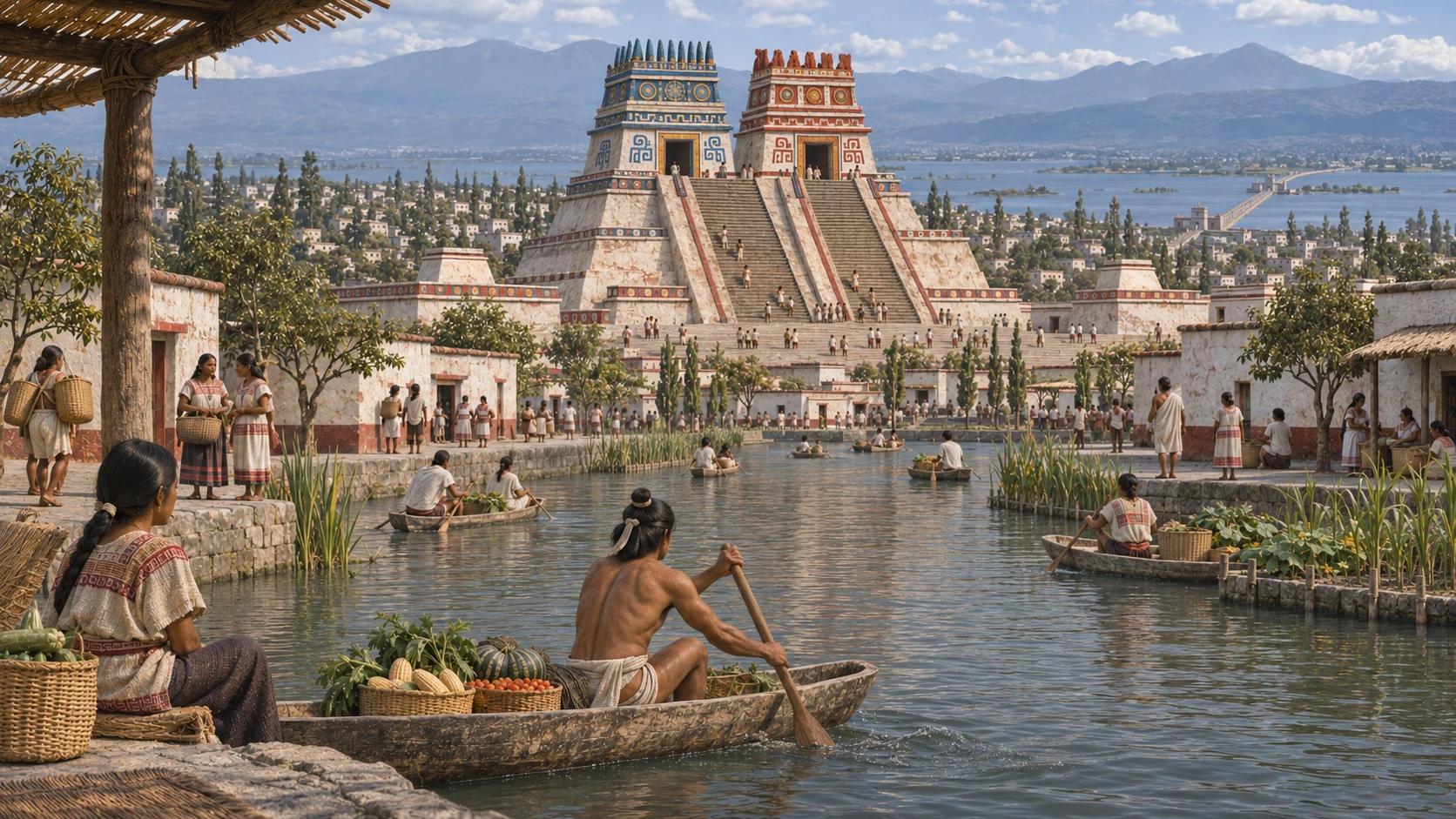
Tenochtitlan at its height, with dense neighbourhoods, canals, causeways and the twin shrines of the Templo Mayor.

Premium Story

The Aztec Empire

Rise with the Aztec Empire from Tenochtitlan’s island foundations to conquest, tribute, and Spanish invasion.

11 chapters

Next
Context

Introduction

Overview

The Aztec Empire grew from the Triple Alliance of , and after the defeat of in 1428. The Mexica of became its dominant power. Warfare, tribute and diplomacy connected many communities without making them one uniform state. The capital's fall in 1521 followed Spanish invasion, shifting Indigenous alliances, epidemic disease and siege.

Key forces

Mexica families build reed-and-thatch homes beside shallow water and a dugout canoe on a marshy island.
1325 CE
Step 1 of 101325 CEAccessible mode

The Founding of Tenochtitlan

The Mexica built their home on an island in a lake. Later generations remembered its foundation as the fulfilment of a sacred promise.

's foundation is traditionally dated to 1325. Accounts of Mexica migration describe a long search for a place among the established communities of the Valley of Mexico.

Their founding traditions linked the site to Huitzilopochtli and an eagle on a cactus. Such stories expressed a sacred connection to the city; they are not an eyewitness record of its first settlement.

The lake presented difficulties and opportunities. Its waters offered routes for transport and some protection, but the island depended on access to food, fresh water and neighbouring communities.

The Mexica extended the island, built canals and causeways, and developed productive raised fields called chinampas. These plots stood in shallow wetlands; they did not float. The growing city drew on farming methods already known in the region.

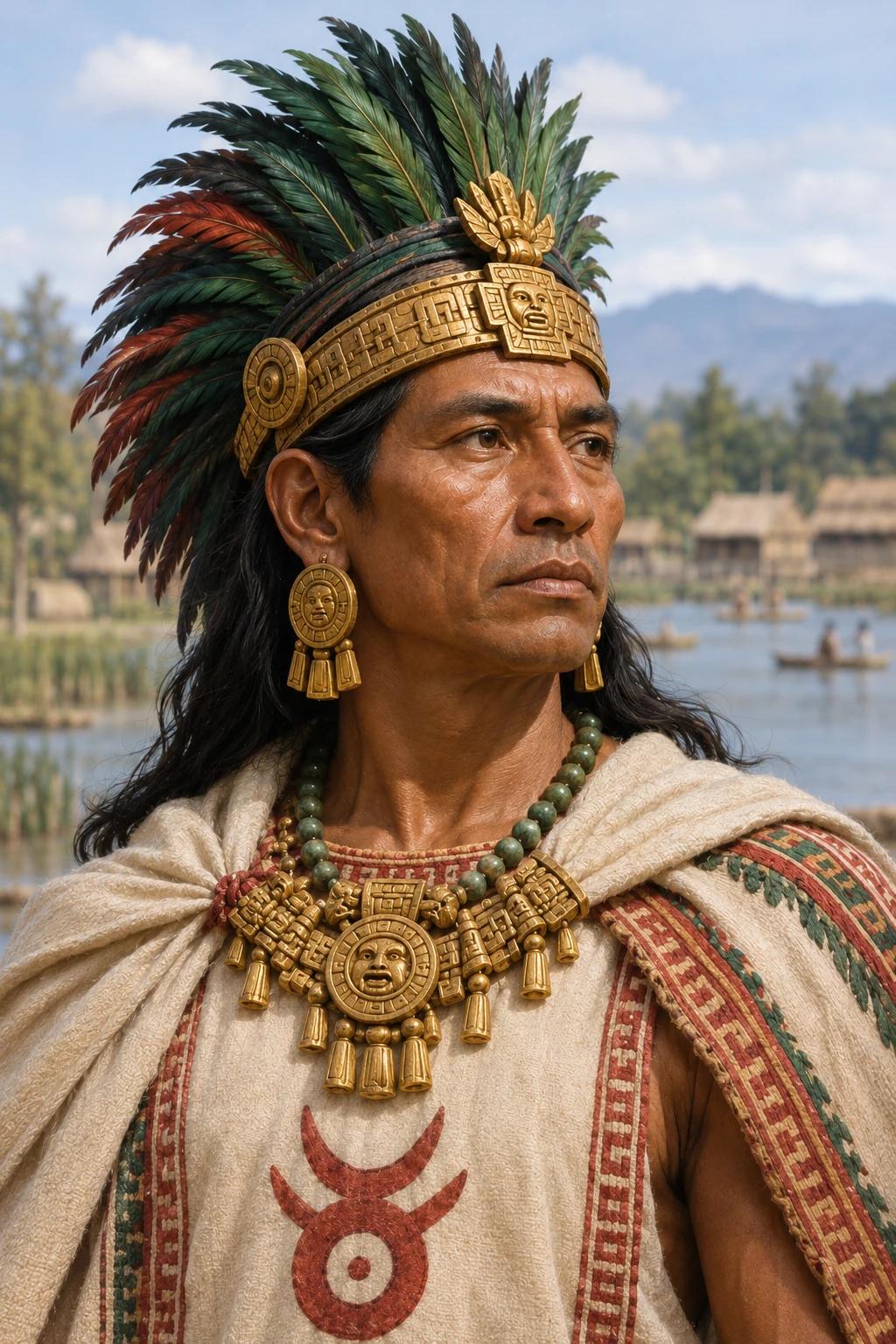
Acamapichtli watches Mexica porters deliver maize and cloth to a seated Tepanec official as a scribe records the tribute.
1375 CE
Step 2 of 101375 CEAccessible mode

The Rise Under Tepanec Rule

Before they became an imperial power, the Mexica served stronger neighbours and built connections within their political world.

After founding , the Mexica were not free. They owed loyalty and military service to , the Tepanec city that dominated the region.

Acamapichtli became 's first recognised tlatoani in the later fourteenth century, often dated to 1375. His noble connections linked the Mexica royal house to older traditions of rulership.

Mexica warriors served in Tepanec campaigns. Military service and marriages between ruling families helped improve its position while it remained subordinate.

The Mexica took part in a system of tribute, warfare and negotiation that already connected the region. Their later empire grew from this shared political experience.

By the early fifteenth century, the Mexica were stronger, more experienced, and increasingly aware of their own potential.

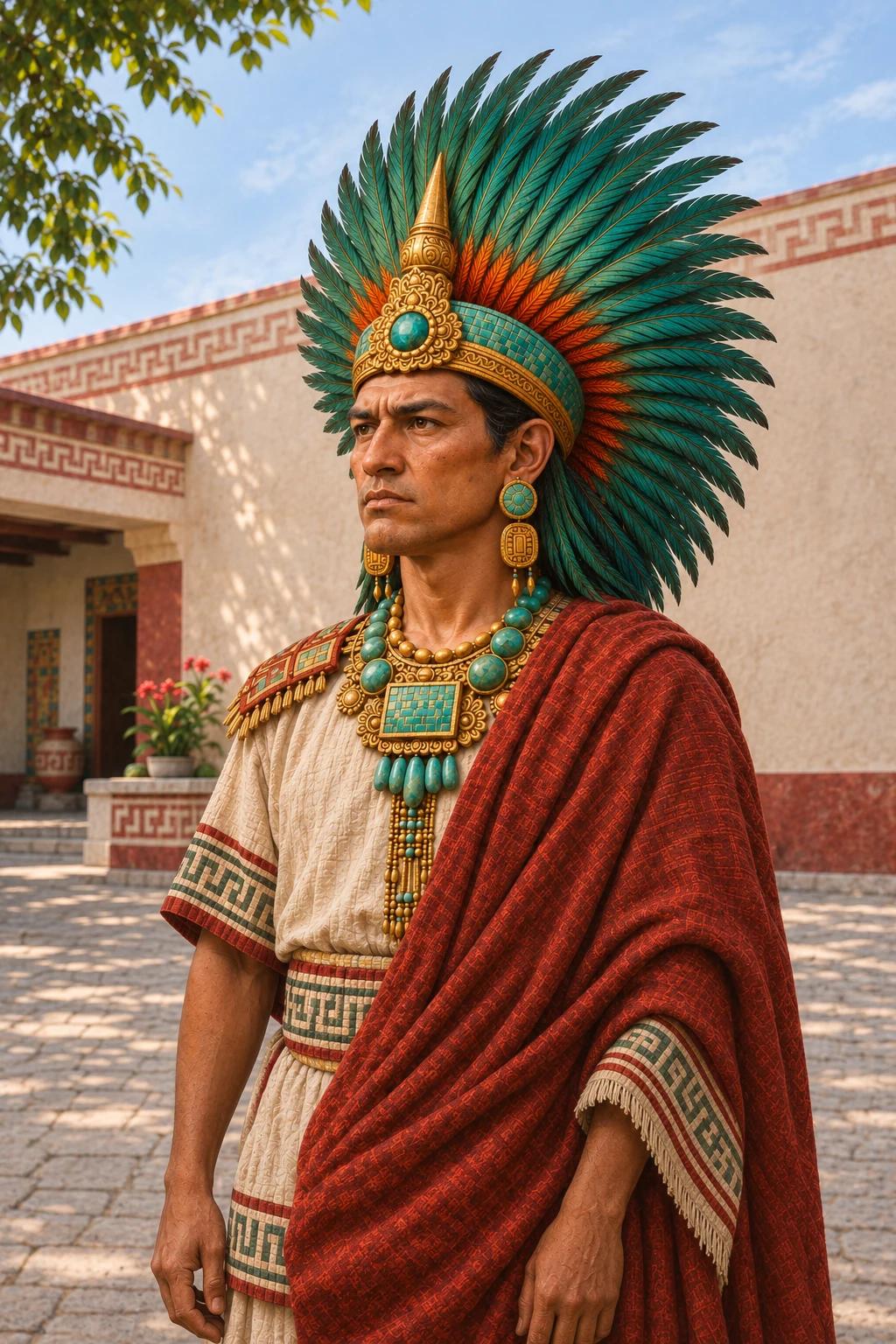
Itzcoatl directs allied warriors across a timber bridge toward defenders behind a canal-side barricade.
1428 CE
Step 3 of 101428 CEAccessible mode

The War Against Azcapotzalco

In 1428, the Mexica rose against their former masters and transformed themselves into the rulers of a new empire.

After decades of service, the Mexica had grown strong enough to fight for independence. Their chance came when 's ruler died and a succession dispute weakened Tepanec power.

joined forces with supporters of Nezahualcoyotl of against . Victory in 1428 opened the way to the Triple Alliance with and .

The victory changed the balance of power in the valley. Building a lasting imperial system took further campaigning, negotiation and cooperation.

The three partners shared tribute and authority unequally. received a smaller share, while increasingly led military expansion. remained an important power in its own right.

The war against did not just end Tepanec dominance. It created the framework for everything the Aztec Empire would become.

PremiumFree preview: 3 of 10 chapters

Continue The Aztec Empire

Sign up to a Premium account to read the remaining chapters of this story.

A paid Premium subscription also gives you full access to every other Premium story.
See Premium options

Coming next

  1. Chapter 4The Imperial Reforms of Itzcoatl
  2. Chapter 5The Expansion of Tribute Empire
  3. Chapter 6Religion at the Center of Power

And 4 more chapters to follow.

Keep exploring

Follow the connected history

Explore closely connected stories and free figure profiles. Premium stories open with a public preview.

References

Sources and historical notes

Sources used to check this page, selected recommendations and historical notes.

Sources used

  1. The Metropolitan Museum of Art, “Mexico, 1000–1400 A.D.,”

    Read overview and migration, foundation, Tepanec and Acamapichtli entries. Supports traditional early chronology and c.1375 accession rather than the previous unqualified 1372. Does not establish an uncontested exact foundation day.

    Open source
  2. Universidad Nacional Autónoma de México, CCH, “Imperio mexica,”

    Read political emergence, coalition, tribute shares, expansion and varying subject relationships. Tlacopan is itself Tepanec; Tenochtitlan’s military leadership does not erase Texcoco. Chronological differences over Chimalpopoca’s death are not resolved by choosing an unsupported exact date.

    Open source
  3. Universidad Nacional Autónoma de México, CCH, “El Estado mexica,”

    Read rulership chronology, noble authority, court protocol, councils and calpulli. The 1375–1395 reign is used as a conventional chronology, not proof of Acamapichtli’s birth and death years. Institutions are not all assigned to one reform in 1431.

    Open source
  4. Stephanie Wood, University of Oregon, Visual Lexicon of Aztec Hieroglyphs, “Tenochtitlan (Mdz2r),”

    Read scholarly description of the Codex Mendoza eagle, cactus and stone glyph, its variations and manuscript context. Founding iconography is distinguished from eyewitness proof; no image is copied or relicensed.

    Open source
  5. Food and Agriculture Organization of the United Nations, “Chinampas Agricultural System in Mexico City,”

    Read local knowledge, construction, cropping and water-management sections. Uses the detailed raised-field construction account rather than treating the introductory floating-island label literally. Modern crop inventories are not projected unchanged into 1500.

    Open source
  6. Instituto Nacional de Antropología e Historia, “Exploran chinampas y canales de un barrio de la antigua México-Tenochtitlán,”

    Read excavation report on Ateponazco, field foundations, stakes, canals and crops. Supports fixed raised plots and urban agricultural space, not an invention by the Mexica at the instant of foundation.

    Open source
  7. Agnes Bencze and Heidi King, The Metropolitan Museum of Art, “Tenochtitlan,”

    Read city layout, perhaps 200,000 population, reclaimed land, waterways, aqueducts, precinct, neighbourhoods and court spaces. Estimate is qualified; no assertion that it exceeded every European city or was the greatest in the Americas is retained. Colonial rebuilding is described as development over and around the damaged city.

    Open source
  8. Clementina Battcock, Estudios de Cultura Náhuatl, UNAM, “Acerca de las pinturas que se quemaron y la reescritura de la historia en tiempos de Itzcóatl,”

    Selected opening pages read, especially printed pp.96–97 (PDF pp.2–3), including Sahagún/Florentine Codex passage and the statement that researchers offer different interpretations. Not a claim to have read every page. Supports attribution and uncertainty rather than asserting wholesale erasure and replacement of all history.

    Open source
  9. Jorge Gómez Tejada, Ancient Mesoamerica, “The Matrícula de Tributos: Stylistic and Material Observations into Its Dating and Original Context,”

    Public abstract and metadata read, not full article. The proposed composite folios may range from around 1521 into the 1560s. Used to remove the implication that the surviving manuscript is a ledger directly from Moctezuma I’s reign.

    Open source
  10. The Metropolitan Museum of Art, “Mexico, 1400–1600 A.D.,”

    Read overview and chronological entries: alliance, c.1431 temple enlargement, Moctezuma I, Tlatelolco, Ahuitzotl, 1487 monument, 1519–1521 and colonial consequences. The c.1427 alliance entry is cross-checked against UNAM’s conventional 1428; precise casualty claims and fully levelled-city shorthand are not repeated.

    Open source
  11. Laura García J., Ciencia UNAM, with Guilhem Olivier, “Sacrificios Humanos: Sangre para los Dioses,”

    Read discussion of human sacrifice, divine sustenance, varied victims and mismatch between reported 1487 totals and archaeological evidence. Confirms the practice without supplying an exact count for the dedication. Graphic details are not reproduced.

    Open source
  12. Ross Hassig, Arqueología Mexicana, “El sacrificio y las guerras floridas,”

    Read discussion of ritual and political interpretations, including criticism of the idea that Mexica were unable to fight lethal wars. Its repeated large dedication totals are not adopted as established counts.

    Open source
  13. Secretaría de Cultura, Sistema de Información Cultural, “Templo Mayor,”

    Read description and location beside the cathedral, paired shrines and archaeological remains. Corrects the cathedral-directly-on-temple-footprint statement. No claim to audit image rights or identify every sacrifice victim.

    Open source
  14. Nancy Fitch, American Historical Association, “The Conquest of Mexico: Timeline,”

    Read 1519–1521 sequence: Tlaxcalan fighting and alliance, Cholula, November entry and custody, Toxcatl, retreat, later epidemic and final siege. The June 1529 typo and incorrect 1492 island identification are excluded. Cuauhtemoc’s accession is kept broad because chronologies differ.

    Open source
  15. Benson Latin American Collection, University of Texas at Austin, “A New Spain: Invasion of Mexico,”

    Read narrative and Lienzo de Tlaxcala context, especially Tlaxcalteca, Texcoca factions, Malintzin and postwar petition for tribute exemption. Its shorthand making every Totonac community independent is not generalised; political status varied.

    Open source
  16. Denver Art Museum, “Traitor, Survivor, Icon: The Legacy of La Malinche,”

    Read exhibition framing of an enslaved Indigenous girl, interpreter and cultural translator. Supports her active role and constrained circumstances without inventing her private motives.

    Open source
  17. Nancy Fitch, American Historical Association, “Who Was Malinche?,”

    Read source discussion, Aguilar, enslavement and limits of names, motives and later depictions. Biographical claims such as its late proposed death date are not imported. No claim is made to have read all documents linked from the essay.

    Open source
  18. Federico Navarrete, UNAM Noticonquista, “Destruir las naves. Una decisión estratégica,”

    Read the essay: later disabling of ships, retained equipment, internal dissent, coastal alliances and later brigantines. Rejects burning legend and an immediate single-man act at the moment of April landfall. Detailed speculative motives are not asserted as direct knowledge.

    Open source
  19. Florentine Codex, Book 12, chapter 29, translated extract hosted by the American Historical Association, “Plague Strikes Tenochtitlan,”

    Read selected translated Nahua testimony about illness, hunger, lack of care and renewed fighting. A colonial-era compiled account, not a census, modern clinical dataset or direct transcript of every 1520 household. No direct quotation or numerical death total is added.

    Open source
  20. Florentine Codex, Book 12, chapter 11, translated extract hosted by the American Historical Association, “Mexica Account of Cholula Massacre,”

    Read the narrative of Tlaxcalan hostility, armed entry, assembled inhabitants and killing. Its attribution of motives and responsibility is one perspective, not a complete adjudication of all versions. Map copy names the massacre without an unsupported total or pyramid superlative.

    Open source
  21. Rafael López, Gaceta UNAM, “Recrean la vajilla de Moctezuma II, señor del Anáhuac,”

    Read identity and 1466–1520 life / 1502–1520 reign distinction and acknowledgement of conflicting death accounts. The article’s unqualified Cortes-as-Quetzalcoatl claim, baptism claim and impossible 1521 dining date are excluded.

    Open source
  22. Miguel Pastrana Flores, Arqueología Mexicana, “La vida de Cuauhtémoc: los primeros años,”

    Public extract read, not the entire magazine article. Explicitly states no surviving record establishes his birth year; estimates vary from 1496 to 1503. Removes the exact numeric birth value from this story’s figure card and labels uncertainty.

    Open source
  23. Biblioteca Nacional de Chile, Memoria Chilena, “Francisco Pizarro, 1478–1541,”

    Read collection identity and date metadata only. Supports the retained contextual figure reference, not the portrait’s authenticity or a claim to read the depicted historical volume. Birth is qualified in the displayed role.

    Open source
  24. Bibliothèque nationale de France, “Atahualpa (1502?–1533), authority record,”

    Read identity and uncertain birth field. Story removes the unsupported exact numeric 1500 and gives an uncertain birth; no exact execution day or universal last-Inca title is introduced.

    Open source
  25. Biblioteca Virtual Miguel de Cervantes / Biblioteca Nacional de España, “Historia de Cristóbal Colón, bibliographic record,”

    Read catalogue record and subject authority approximately 1451–1506; not the complete 1892 work. Used only for the contextual figure reference with approximate birth wording.

    Open source
  26. Kim N. Richter, Getty Research Institute, “Revitalizing an Endangered Indigenous Language,”

    Read account of Nahua educators, living Nahuatl communities and language revitalisation. Supports continuity without treating communities as unchanged remnants of empire; dated speaker totals are not imported.

    Open source
  27. Kim N. Richter, Alicia Maria Houtrouw and Joshua Fitzgerald, Getty Research Institute, “Competing Narratives on the Conquest of Mexico and the Fall of the Aztec Empire,”

    Read manuscript origin, Nahua and Spanish narrative contexts and the value of multiple accounts. Supports treating the Florentine Codex as a 1577 colonial-era compilation with Indigenous authors and perspectives, not an unmediated text produced during the siege.

    Open source
  28. Instituto Nacional de Antropología e Historia, “Ciudad prehispánica de Teotihuacan,”

    Read earlier urban history and later sacred associations. Removes mysterious-city language and claims that every part of the site was empty; gives a qualified name interpretation without imposing one universal translation.

    Open source
  29. Encyclopaedia Britannica, “Aztec,” Open source
  30. The Metropolitan Museum of Art, “Aztec Art,” Open source
  31. Fordham University, “Aztec Account of the Conquest of Mexico,” Open source

Image references

  1. The British Museum, “Mexico,” Open source

Additional sources and notes

Loading reviewed claim sources...

Our editorial approach · Report a historical error

A monthly route through history

Find out first about the latest published stories, feature notes and occasional Premium offers in one monthly email.